
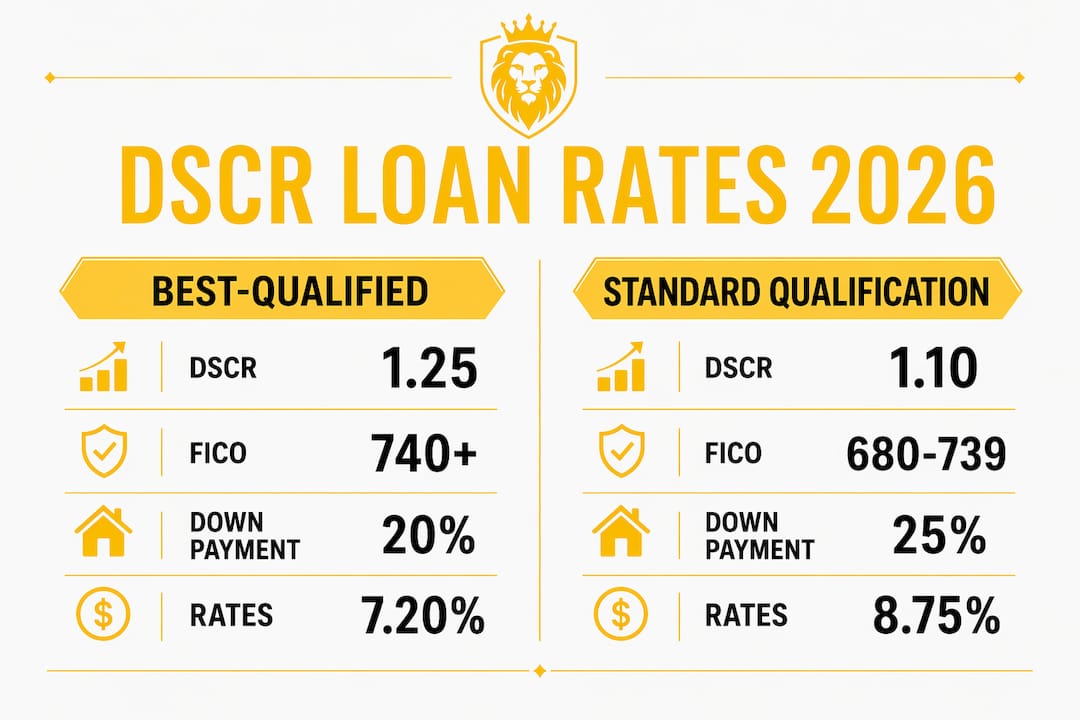
DSCR loan rates in July 2026 are generally higher than comparable conventional investment property mortgage rates due to their non-QM status, which underwrites loans on property cash flow rather than personal income. Best-qualified borrowers with strong credit profiles and sufficient down payment receive the most favorable pricing, while standard profiles pay higher rates reflecting their risk tier.
Key benchmarks for 2026:
- Best-qualified borrowers with high credit scores, strong DSCR, and substantial down payment access the lowest rate tiers.
- Strong profiles with slightly lower credit or down payment receive moderately higher rates.
- Standard profiles with average credit and DSCR pay higher rates reflecting increased risk.
- Moderate credit and DSCR scores correspond with further elevated rates.
- Most lenders require minimum DSCR of about 1.0; sub-1.0 ratios are financed through specialty products at higher pricing.
- Promotional rates apply primarily to top-tier borrower profiles and are not representative of typical investor costs.
The Freddie Mac PMMS benchmark for primary residences was around mid-6% in July 2026. DSCR loans generally carry an additional premium over this baseline, reflecting their smaller secondary market and qualification criteria that differ from traditional income verification.
Key benefits of DSCR loans for real estate investors
DSCR loans qualify based on the rental income a property generates, not the borrower's W-2s, tax returns, or debt-to-income ratio. That distinction opens financing to self-employed investors, those with complex tax structures, and portfolio builders who have already maxed conventional loan counts.
- No personal income documentation required. Qualification rests on the property's gross rental income versus its monthly debt obligations.
- No limit on financed properties. Conventional Fannie/Freddie programs cap investors at 10 financed properties; DSCR programs carry no such ceiling.
- Purchase and cash-out refinance both available. Investors can acquire new rentals or pull equity from existing ones under the same program structure.
- LLC and entity vesting permitted. Most DSCR lenders allow title in an LLC, which simplifies liability management for portfolio investors.
- Accessible across credit profiles. FICO scores as low as 620 are accepted by several lenders, though rates rise 0.50%–0.75% below the 720 tier.
- Multiple loan structures available. 30-year fixed, 5/1 ARM, 7/1 ARM, interest-only, and 40-year amortization products all exist within the DSCR framework, giving investors flexibility to match loan structure to hold strategy.
Pro Tip: For buy-and-hold investors planning a 5+ year hold, a 30-year fixed with a 5-year step-down prepayment penalty typically produces the lowest rate available on that file.

DSCR loan qualification requirements explained
Lenders evaluate four primary variables when underwriting a DSCR loan: the DSCR ratio itself, FICO score, LTV, and property type. Each variable maps to a rate tier rather than a binary approval or denial.
- DSCR ratio. A ratio of 1.25 or above earns base pricing. Ratios between 1.0 and 1.24 carry a 0.20%–0.375% rate add. Ratios below 1.0 fall into no-ratio or sub-1.0 specialty programs at 8.00%–9.50%, with LTV caps of 65%–70%.
- Credit score. The 740+ tier receives best pricing. Each step down adds to the rate, with the 620–659 band seeing 30-year fixed rates of 8.20%–9.20%.
- Down payment / LTV. Most programs require 20%–30% down. A 65% LTV (35% down) earns the lowest rate tier; 80% LTV (20% down) adds 0.20%–0.50% versus the 75% LTV benchmark.
- Property type. Single-family residences are the baseline. Condominiums add 0.125%–0.375%; short-term rentals add 0.20%–0.50%; 5+ unit multifamily adds 0.20%–0.50% with a lower LTV cap.
- Documentation required. Lenders need a lease agreement or market rent appraisal (Form 1007), property insurance, title, and entity documents if vesting in an LLC. No W-2s, no tax returns, no pay stubs.
| Borrower Profile | DSCR | FICO | Down Payment | Rate Range (30-yr fixed) |
|---|---|---|---|---|
| Best-qualified | 1.25+ | 740+ | 30%+ | 7.25%–7.60% |
| Strong | 1.25+ | 720–739 | 20% | 7.60%–8.00% |
| Standard | 1.0–1.24 | 680–719 | 20% | 8.00%–8.50% |
| Moderate | Below 1.25 | 660–679 | 20% | 8.75% and above |
| Challenging | Below 1.0 | Below 660 | 20% | 8.75% and above |
How DSCR loan rates are calculated and what drives pricing
DSCR rates function as a grid, not a single number. The same investor file produces different quotes depending on transaction type, loan structure, prepayment terms, and property characteristics.
- DSCR ratio and FICO are the two largest borrower-controlled variables. Moving from 680 to 740 FICO can reduce the rate by 0.50%–0.75%, worth roughly $200/month on a $400,000 loan.
- Loan type affects pricing directly. A 5/1 ARM prices 0.20%–0.50% below a 30-year fixed on the same file. Interest-only products add 0.125%–0.20% over fully amortizing equivalents.
- Cash-out refinances carry a rate premium. Cash-out DSCR loans run 0.20%–0.50% above purchase or rate-term refinance pricing, with LTV capped at 70%–75%.
- Prepayment penalty terms trade rate for flexibility. Accepting a 5-year step-down penalty can reduce the rate by 0.50%–1.0% versus a no-penalty structure. Investors who plan to hold for 5+ years typically benefit from accepting the penalty.
- Geographic overlays are minor. Most lenders price uniformly across all 50 states, with state-specific spreads typically under 0.125%.
- Rate lock length adds cost. A 45–60 day lock adds 0.125%–0.20% versus a standard 30-day lock.
The 10-year US Treasury yield serves as the primary benchmark for DSCR rate movement. DSCR loans carry a spread of roughly 200–350 basis points above that index, wider than the 150–225 basis point spread on conventional investment property loans, reflecting the non-QM risk premium.

Downsides of DSCR loans investors should weigh carefully
The income-verification flexibility of DSCR loans comes at a real cost. Investors who qualify for conventional financing will almost always find lower rates through Fannie/Freddie programs.
- Higher base rates. DSCR loans price 0.5%–1.20% above conventional investment property mortgages and further above primary residence rates.
- Prepayment penalties are standard. Most competitive DSCR rates come attached to 3–5 year step-down penalties. Selling or refinancing early triggers a penalty calculated on the outstanding balance.
- Higher down payment requirements. The 20%–30% down payment range is standard, compared to lower thresholds available on some conventional programs.
- Property type restrictions. Condotels, rural properties, and certain mixed-use assets either face significant rate premiums or fall outside eligible property guidelines entirely.
- Promotional rates mislead planning. Advertised "from" rates under 6.5% apply only to the strongest borrower profiles. Most investors should budget for 7.50%–8.50% to avoid rate adjustments during underwriting.
- Thin DSCR margins are costly. A DSCR below 1.0 pushes the file into specialty no-ratio products with substantially higher pricing and reduced LTV limits.
Sistar Mortgage vs Texas United Mortgage for DSCR loans
Both lenders serve real estate investors with DSCR and non-QM products, but their geographic focus and program depth differ in ways that matter depending on where and how you invest.
| Lender | Interest Rate Ranges | Credit Score Requirements | Min Down Payment | Loan Types Offered | Special Features | Customer Rating |
|---|---|---|---|---|---|---|
| Sistar Mortgage | Competitive; not publicly listed | Not publicly listed | Not publicly listed | Conventional, FHA, VA, USDA, Jumbo, Non-QM, Construction, One-Time Close | Flexible rates, construction financing, personalized Michigan-based service | 4.8★ (383 reviews) |
| Texas United Mortgage | Competitive; not publicly listed | Flexible; low minimums accepted | Low down payment options available | Conventional (10/30-year, custom terms), FHA, VA, USDA, Jumbo, Down Payment Assistance | Credit-flexible programs, down payment assistance, rental property and vacation home financing | 4.9★ (148 reviews) |
Sistar Mortgage is a Michigan-based lender with a broad product menu that includes one-time close construction financing alongside conventional and government-backed options. For investors who want to build a rental property from the ground up and roll construction into a permanent DSCR loan, Sistar's construction-to-permanent capability is a practical differentiator. The lender emphasizes personalized service and flexible rate structures across its non-QM and conventional programs.
Texas United Mortgage operates out of Houston and specializes in credit-flexible programs with low down payment options and down payment assistance. Its focus on rental property purchases, vacation homes, and customized loan terms makes it well-suited for Texas-based investors who need tailored underwriting rather than a one-size program. The lender's FHA Streamline and VA IRRRL refinance options also give existing borrowers efficient paths to rate reduction.
For investors outside Texas or Michigan, both lenders may still be worth contacting for rate quotes, as DSCR programs are often available across state lines.
Jaken Finance Group offers a different path for active investors
DSCR loans are the right tool for stabilized rentals with documented cash flow. But many real estate investors need capital before a property reaches that stage, whether for a fix-and-flip, a new construction project, or a value-add acquisition that does not yet qualify for DSCR underwriting.
Jaken Finance Group provides asset-based hard money loans with no minimum credit score requirement, closings in as few as five days, and underwriting focused on the property's value rather than the borrower's financial profile. That structure serves investors who cannot wait for conventional or DSCR timelines, or whose current deal does not fit the income-verification framework DSCR lenders require. Once a property is stabilized and generating rental income, a DSCR rental loan becomes the logical next step. Jaken Finance Group supports both stages of that cycle.
Key Takeaways
DSCR loan rates in 2026 range from 7.20% to 8.75% for most investor profiles, with pricing driven primarily by FICO score, DSCR ratio, LTV, and loan structure rather than market conditions alone.
| Point | Details |
|---|---|
| Current rate range | Most investors should budget for 7.50%–8.50% on a 30-year fixed DSCR loan in 2026. |
| Rate premium over conventional | DSCR loans price 0.5%–1.20% above conventional investment property mortgage rates. |
| Biggest rate lever | Moving from 680 to 740 FICO can reduce your rate by 0.50%–0.75% on the same file. |
| Prepayment penalty tradeoff | Accepting a 5-year step-down penalty reduces the rate by 0.50%–1.0% for buy-and-hold investors. |
| Jaken Finance Group | Offers asset-based hard money and DSCR rental loans for investors at every stage of the acquisition cycle. |