
DSCR loan closing costs are upfront fees paid at settlement, typically ranging from 2% to 5% of the loan amount. On a $400,000 loan, that means budgeting between $8,000 and $20,000 before the down payment. These costs cover lender charges, third-party services, prepaid insurance, property taxes, and escrow reserves. DSCR loans, formally classified as non-qualified mortgages (non-QM), carry higher fees than conventional financing because lenders price in the added complexity of asset-based underwriting. Investors who understand the full DSCR loan cost breakdown before signing a term sheet avoid the cash shortfalls that kill deals at the closing table.
What are the main types of DSCR loan closing costs?
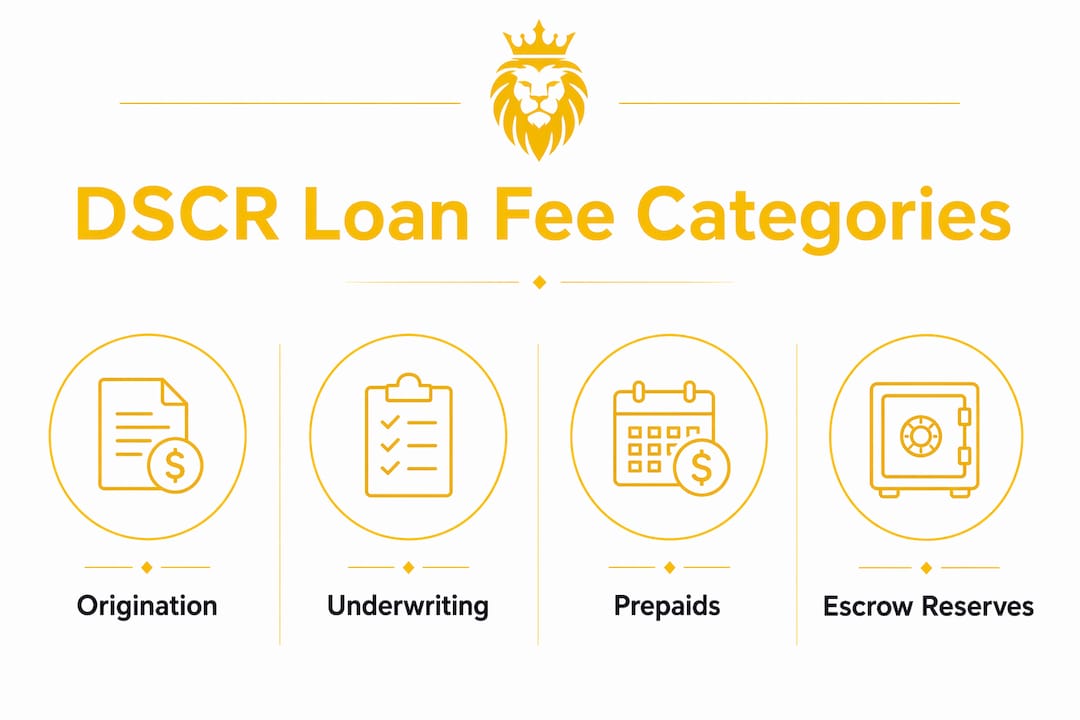
DSCR closing costs fall into four distinct categories. Each category serves a different purpose, and confusing them leads to budget errors.

Lender fees are charges the lending institution collects directly. Origination fees are the largest single expense, typically 0.5% to 2% of the loan amount. Underwriting and processing fees together can reach $1,200 to $2,500, which is higher than conventional loans because non-QM underwriting requires specialized review of rental income, DSCR ratios, and property cash flow.
Third-party fees cover services performed by outside vendors:
- Appraisal: $500–$800 for a standard single-family rental; more for multifamily
- Title insurance: Lender's policy typically $500–$1,500 depending on loan size and state
- Escrow or settlement fee: $500–$1,200 paid to the closing attorney or title company
- Recording fees: $50–$200 paid to the county recorder
Prepaid items are expenses collected at closing to fund future obligations. These include the first year of homeowner's insurance, a property tax proration, and prepaid interest covering the days between closing and the first payment due date.
Escrow reserves are separate from prepaids. Lenders require investors to deposit months of PITIA (principal, interest, taxes, insurance, and association dues) into a reserve account at closing. This is where many investors get surprised.
| Fee Category | Typical Range | Paid To |
|---|---|---|
| Origination fee | 0.5%–2% of loan | Lender |
| Underwriting and processing | $1,200–$2,500 | Lender |
| Appraisal | $500–$800+ | Third-party appraiser |
| Title insurance (lender's policy) | $500–$1,500 | Title company |
| Escrow/settlement fee | $500–$1,200 | Title or escrow company |
| Prepaid interest | Varies by closing date | Lender |
| Escrow reserves (PITIA) | 3–12 months | Escrow account |
Pro Tip: Request an itemized Loan Estimate within three business days of application. Federal law requires lenders to provide this document, and it gives you a line-by-line view of every projected fee before you commit.
Why are DSCR loan fees higher than conventional mortgage costs?
DSCR loans carry higher fees because they operate outside the qualified mortgage (QM) framework set by the Consumer Financial Protection Bureau (CFPB). Conventional lenders follow standardized Fannie Mae and Freddie Mac guidelines, which reduce underwriting labor and risk. DSCR lenders evaluate each deal on property-level cash flow, which requires more manual analysis.
Several factors drive up the total cost:
- Non-QM underwriting complexity: Analysts review rent rolls, lease agreements, and DSCR ratios rather than W-2 income, adding labor costs that get passed to the borrower.
- Higher origination fees: Lenders charge more to compensate for the specialized risk evaluation and the secondary market pricing on non-QM paper.
- Larger escrow reserves: Risk management policies require 3 to 12 months of PITIA in reserve, a requirement rarely seen on owner-occupied conventional loans.
- No private mortgage insurance (PMI): DSCR loans do not require PMI, but lenders price that risk into higher interest rates and origination fees instead.
- Rate-lock and appraisal deposit risk: Upfront fees like appraisal deposits and rate-lock fees may be non-refundable if the loan does not close, adding financial exposure not present in conventional pre-approval processes.
The net effect is a higher cash-to-close figure. Investors comparing DSCR loan expenses against conventional financing should use the DSCR vs. conventional cost comparison to model the true difference before selecting a product.
Pro Tip: A DSCR term sheet is non-binding. Confirm in writing which upfront fees are refundable before paying any deposit, especially appraisal and rate-lock charges.
How can investors reduce or negotiate closing costs for DSCR loans?
Reducing DSCR loan expenses requires active negotiation, not passive acceptance of the first quote. The following strategies produce measurable savings.
-
Shop multiple lenders through a wholesale broker. Investors using brokers with access to 50+ lenders consistently see lower origination fees than investors who accept a single retail lender quote. Wholesale pricing removes the retail markup on origination points.
-
Negotiate seller credits. Most DSCR loan programs allow seller credits of 3% to 6% of the purchase price. These credits reduce cash needed at closing without affecting the down payment. Seller credits are underutilized by investors, yet they represent one of the largest available savings at the closing table.
-
Challenge junk fees. Technology fees, compliance fees, and investor review fees are often padded line items that lenders add to the fee schedule. Questioning these charges during the underwriting review frequently results in their reduction or removal. Ask the lender to justify each fee in writing.
-
Evaluate an escrow waiver. Some lenders allow investors to waive the escrow impound account in exchange for a small rate increase, typically 0.125% to 0.25%. For investors with strong liquidity who prefer to manage tax and insurance payments directly, this trade-off can free up significant cash at closing.
-
Use discount points strategically. Paying points upfront lowers the interest rate. This only makes financial sense if the hold period is long enough to recoup the cost. Calculate the break-even point: divide the cost of the points by the monthly payment savings to find the number of months required to recover the investment.
The DSCR calculator for rental properties helps investors model total acquisition costs, including closing fees, to determine whether a deal still meets return thresholds after accounting for all upfront expenses.
What is the DSCR loan closing process timeline?
The DSCR loan closing process spans 21 to 45 days from application to funding. That timeline is longer than hard money loans but shorter than most conventional investment property mortgages. Delays almost always trace back to missing documents or appraisal scheduling gaps.
The process moves through five sequential phases:
- Application: Investor submits property details, entity documents, and financial information. The lender issues a Loan Estimate within three business days.
- Appraisal: A licensed appraiser inspects the property and delivers a market value report. This phase typically takes 7–14 days and cannot begin until the appraisal deposit is paid.
- Title work: A title company searches for liens, ownership issues, and encumbrances. Title insurance commitments are issued before closing.
- Underwriting: The lender's credit team reviews the full file, verifies the DSCR ratio, and issues a conditional approval or clear-to-close.
- Closing: The investor signs documents, funds are wired, and the deed records with the county.
| Phase | Typical Duration | Key Requirement |
|---|---|---|
| Application | 1–3 days | LLC docs, insurance binder, proof of funds |
| Appraisal | 7–14 days | Appraisal deposit, property access |
| Title work | 5–10 days | Clear title, no open liens |
| Underwriting | 5–10 days | Lease agreements, DSCR verification |
| Closing | 1–2 days | Wire transfer, signed closing disclosure |
Having LLC formation documents, an insurance binder, and proof of funds ready before application submission removes the most common delay points. Investors new to DSCR financing can review the DSCR loan for investment property page for a full document checklist.
How do prepaid items and escrow reserves affect cash to close?
Prepaid items and escrow reserves are often the largest line items on a closing disclosure, yet they are not lender fees or third-party costs. This distinction matters because these funds are not lost. They are deposited into accounts that pay future obligations on the investor's behalf.
Prepaids typically include:
- First-year homeowner's insurance premium: Paid in full at closing, usually $1,200–$3,000 depending on property type and location
- Property tax proration: The seller's share of taxes owed from the last payment date to closing
- Prepaid interest: Interest accruing from the closing date to the end of the month, before the first full payment begins
Escrow reserves are separate deposits held by the servicer. DSCR lenders require 3 to 12 months of PITIA upfront as a safety margin against payment default. On a property with $2,500 in monthly PITIA, a six-month reserve requirement adds $15,000 to the cash-to-close figure. Investors who do not plan for this requirement risk deal failure even when they have sufficient funds for the down payment and standard fees.
Pro Tip: Ask your lender for the exact escrow reserve requirement during the pre-approval stage, not at closing. Some lenders allow a reduced reserve for investors with strong liquidity documentation, such as six months of bank statements showing consistent balances.
Key Takeaways
DSCR loan closing costs range from 2% to 5% of the loan amount, and escrow reserves can add thousands more to the cash-to-close figure that investors must plan for in advance.
| Point | Details |
|---|---|
| Total cost range | Budget 2%–5% of the loan amount for closing fees, plus escrow reserves. |
| Largest lender fee | Origination fees of 0.5%–2% represent the single biggest lender charge. |
| Escrow reserve impact | Reserves of 3–12 months of PITIA significantly increase cash needed at closing. |
| Best cost reduction strategy | Shopping wholesale brokers and negotiating seller credits of 3%–6% reduces cash-to-close. |
| Timeline expectation | The closing process takes 21–45 days; document readiness is the primary speed factor. |
What I've learned about DSCR closing costs after years of watching deals fall apart
Most investors who lose a deal at the closing table do not lose it because of the interest rate. They lose it because they did not account for escrow reserves. I have watched experienced investors, people who have closed dozens of deals, get blindsided by a $20,000 reserve requirement they never modeled into their acquisition budget. That number does not show up in the headline rate. It shows up on page three of the closing disclosure, three days before funding.
The second mistake I see constantly is accepting the first lender quote. Origination fees on non-QM products vary more than on conventional loans because there is no standardized pricing grid. A broker with access to a wide lender network will almost always find a lower origination fee than a direct retail lender quote. The difference between 1% and 2% origination on a $500,000 loan is $5,000. That is not a rounding error. That is a month of cash flow.
My strongest advice is to treat the Loan Estimate like a negotiating document, not a final bill. Challenge every fee you cannot get a plain-language explanation for. Technology fees, compliance fees, and document preparation fees are frequently padded. Lenders remove them when investors ask directly. Most investors never ask.
The long-term math on DSCR loans still works in favor of investors who plan correctly. The upfront costs are real, but they are finite. The cash flow from a well-underwritten rental property compounds over years. The investors who succeed are the ones who model the full cost picture before making an offer, not after.
— Jason Taken
Jaken Finance Group and DSCR loan financing
Real estate investors who want transparent DSCR loan pricing and direct access to competitive lender networks work with Jaken Finance Group. The team at Jaken Finance Group helps investors understand every line item on the Loan Estimate before committing to a deal.
Jaken Finance Group operates nationwide and specializes in asset-based lending products built for investors with varying credit profiles. Whether you are financing your first rental or scaling a portfolio, the team provides clear cost breakdowns and access to DSCR investment property loans structured to fit your acquisition budget. Visit Jaken Finance Group to review current loan programs and connect with a lending specialist who can walk through your full closing cost estimate.
FAQ
What is the typical range for DSCR loan closing costs?
DSCR loan closing costs typically range from 2% to 5% of the loan amount. On a $400,000 loan, investors should budget between $8,000 and $20,000, not including the down payment or escrow reserves.
How do escrow reserves differ from closing costs?
Escrow reserves are cash deposits held by the servicer to cover future PITIA payments, not fees paid to the lender or third parties. They increase cash-to-close but are not lost funds since they pay future obligations on the investor's behalf.
Can seller credits cover DSCR loan closing costs?
Most DSCR programs allow seller credits up to 3% to 6% of the purchase price to offset closing costs and prepaids. These credits reduce cash needed at closing without affecting the required down payment.
How long does the DSCR loan closing process take?
The closing process typically spans 21 to 45 days from application to funding. Having LLC documents, an insurance binder, and proof of funds ready at application submission reduces delays significantly.
Are any DSCR loan upfront fees non-refundable?
Appraisal deposits and rate-lock fees paid before closing may be non-refundable if the loan does not close. Investors should confirm the refund policy for each upfront fee in writing before paying.