
What is a DSCR cash out refinance and which lenders offer it?
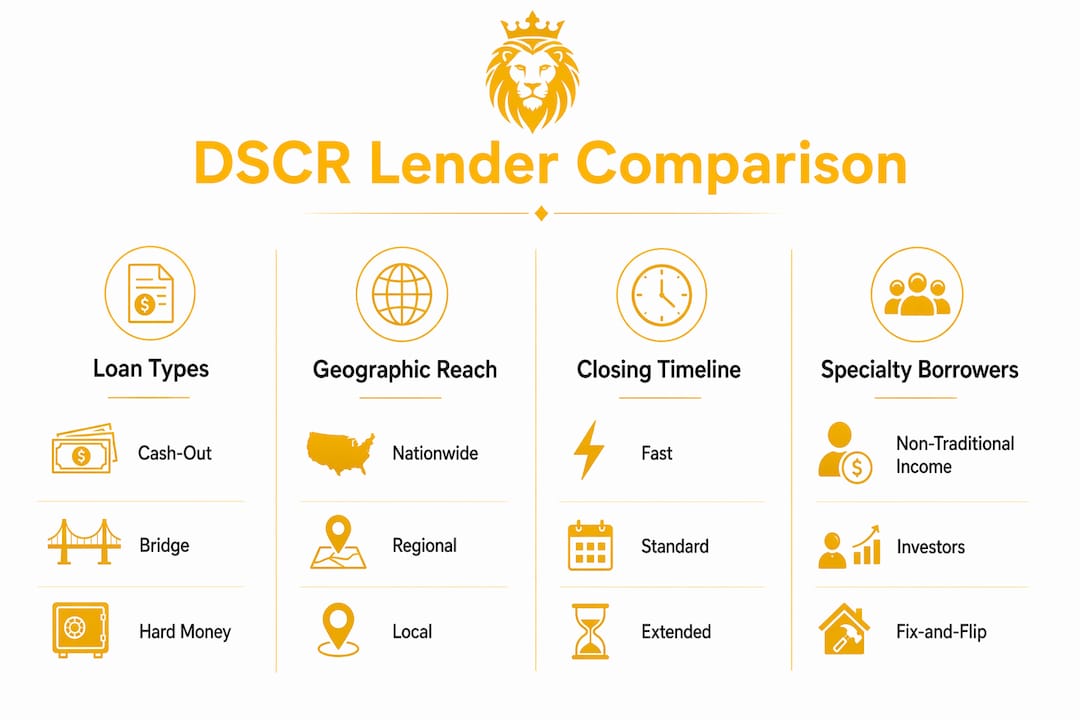
A DSCR cash out refinance replaces an existing rental property mortgage with a larger loan, returning the difference as cash at closing. Qualification rests entirely on the property's rental income relative to the new PITIA (principal, interest, taxes, insurance, and HOA dues), with no W-2s, tax returns, or personal DTI required. That single distinction separates it from every conventional refinance product and makes it the primary equity-extraction tool for investors who hold properties in LLCs or whose personal income documentation no longer fits conventional underwriting.
The core eligibility framework across most programs in 2026:
- Maximum LTV: Most lenders cap DSCR cash-out at 75% LTV; 80% is available on strong-credit files (740+ FICO).
- Minimum DSCR: 1.0 standard; select lenders accept 0.75 at reduced LTV
- Minimum credit score: 660–680 for most programs; some lenders accept 640
- Seasoning: 3–6 months of ownership is required before lenders apply the new appraised value for cash-out.
- Reserves: Typically 6 months PITIA on the new loan
- Borrower types: Individual, LLC, foreign national
Closing costs on a typical DSCR cash-out transaction include origination fees, title, appraisal, and recording costs, which can be significant on loans of this size, covering origination fees, title and settlement, appraisal, and recording costs. Timelines range from 14–21 days for domestic borrowers on clean files; foreign national borrowers generally require additional time due to documentation requirements. Cash-out proceeds are not taxable income because the transaction is a borrowing against equity, not a realization of gain.
The five verified U.S. lenders profiled in this guide cover the full spectrum of investor profiles, from regional Missouri borrowers to nationwide LLC operators seeking no-income-doc loans up to $2 million.
| Lender | Loan Types | Max LTV (Cash-Out) | Specialty Borrowers | Geographic Reach | Closing Timeline | Rating |
|---|---|---|---|---|---|---|
| Haven Home Equity | DSCR refinance, residential | — | Regional investors | Missouri | — | 4.9★ |
| Acra Lending | Non-QM, ARMs, investor loans | — | Self-employed, foreign nationals, investors | 40+ states | — | 3.8★ (426 reviews) |
| DC Lending | Residential, commercial, investor | — | Florida investors, first-time buyers | Florida-focused | Fast (AI-assisted) | 5★ (27 reviews) |
| DCI Mortgage and Investment | Residential, commercial, construction, trust deed | — | Self-employed, challenged credit | California and beyond | — | 5★ (6 reviews) |
| DSCR Loan Funder LLC | DSCR rental, no-doc, interest-only, foreign national | 75% cash-out | LLC borrowers, experienced investors | Nationwide | 20-day average | — |
How to choose the right DSCR cash out refinance lender
Lender selection for a DSCR refinance comes down to five concrete factors: the LTV ceiling they will approve at your DSCR ratio, their seasoning policy, their fee structure, their borrower-type eligibility, and their actual closing speed.
Key evaluation criteria:
- Interest rates and LTV matrix: Rate pricing on DSCR cash-out runs approximately 0.25–0.50% above purchase rates. Confirm the lender's rate at your specific FICO band and LTV tier before comparing headline rates.
- Seasoning policy: Most standard programs require 3–6 months of ownership before applying the new appraised value. Investors exiting hard money or fix-and-flip loans should confirm whether the lender offers delayed financing or a 0-month seasoning option.
- Specialty borrower eligibility: LLC borrowers, foreign nationals, self-employed investors, and borrowers with credit challenges each face different program restrictions. Confirm entity-type acceptance before submitting a file.
- Appraisal methodology: The appraisal determines maximum LTV and the rental income figure used in DSCR calculation. A low rental appraisal can disqualify an otherwise solid asset, so understanding how a lender orders and reviews appraisals matters.
- Fee transparency: Origination points, prepayment penalty structure (typically 3–5 years step-down), and third-party costs should be disclosed upfront.
Common pitfalls to avoid:
- Over-leveraging by drawing the maximum LTV without accounting for post-refi DSCR compression. A new, larger loan balance increases PITIA, which directly reduces the coverage ratio.
- Refinancing without a specific next use for the proceeds. Cash sitting in an account while the new, higher loan accrues interest is a negative-carry position.
- Underestimating total closing costs. Request a written payoff statement itemizing any prepayment penalties on the existing loan before ordering an appraisal.
Pro Tip: Before committing to a lender, run a break-even analysis comparing total closing costs against the monthly cash flow change post-refi. Recovering those costs within a reasonable hold period is the threshold that separates a productive refinance from a costly one.
Investors using DSCR loans for investment property should also verify that the lender's underwriting accounts for fully loaded PITIA costs, not just principal and interest, before projecting post-refi cash flow.
Detailed comparison of top DSCR cash out refinance lenders
Each lender below occupies a distinct position in the market. The right choice depends on property location, borrower profile, and loan size requirements.

Acra Lending
Acra Lending is the strongest option for investors with non-traditional income documentation. With $11 billion in loans funded, 18,000+ broker partners, and 20+ years of Non-QM lending experience, Acra operates at institutional scale across 40+ states. Its programs cover self-employed borrowers, foreign nationals, and investor entities that fall outside conventional underwriting. For investors managing multi-state portfolios who need a lender with deep Non-QM infrastructure and broad licensing, Acra's reach and program depth are difficult to match.
DSCR Loan Funder LLC
DSCR Loan Funder LLC operates as a wholesale direct lender focused exclusively on rental property financing. Rates start at 5.9%, loan amounts reach $2 million, and the average closing time runs 20 days. The product set includes no-income-documentation loans, interest-only options up to 10 years, and explicit support for LLC and foreign national borrowers. For experienced investors and LLC entities seeking competitive wholesale pricing on no-doc DSCR loans, this lender's specialization and loan ceiling make it a primary candidate.
DC Lending
DC Lending targets Florida real estate investors specifically, using AI-assisted approval platforms to accelerate the underwriting process. The lender carries 20+ years of mortgage experience and markets fast closings as a core differentiator. Investors concentrated in Florida who prioritize speed and local market knowledge will find DC Lending's positioning well-matched to their needs.
Haven Home Equity
Haven Home Equity serves investors in Missouri, offering localized DSCR refinancing with in-depth knowledge of that regional market. For investors with Missouri-based rental portfolios who want a lender with direct regional expertise, Haven Home Equity is the logical starting point.
DCI Mortgage and Investment
DCI Mortgage and Investment, located in Santa Clara, CA, covers residential, commercial, and construction loans, with specific programs for self-employed borrowers and clients with credit challenges. The trust deed investment component adds a dimension not found at most DSCR-only lenders. Investors with complex financing needs, including construction or challenged credit profiles, will find DCI's product range more accommodating than a single-product DSCR shop.
Investors evaluating cash flow projections across markets can use the DSCR cash flow analysis framework to stress-test post-refi numbers before committing to a lender.
Jaken Finance Group offers fast, asset-based DSCR loan options
Real estate investors who need speed and flexibility without the documentation burden of conventional lenders have a direct alternative in Jaken Finance Group. While the lenders profiled above each serve specific niches, Jaken Finance Group's asset-based underwriting model operates on a different axis: property value drives qualification, not personal income or credit score minimums.
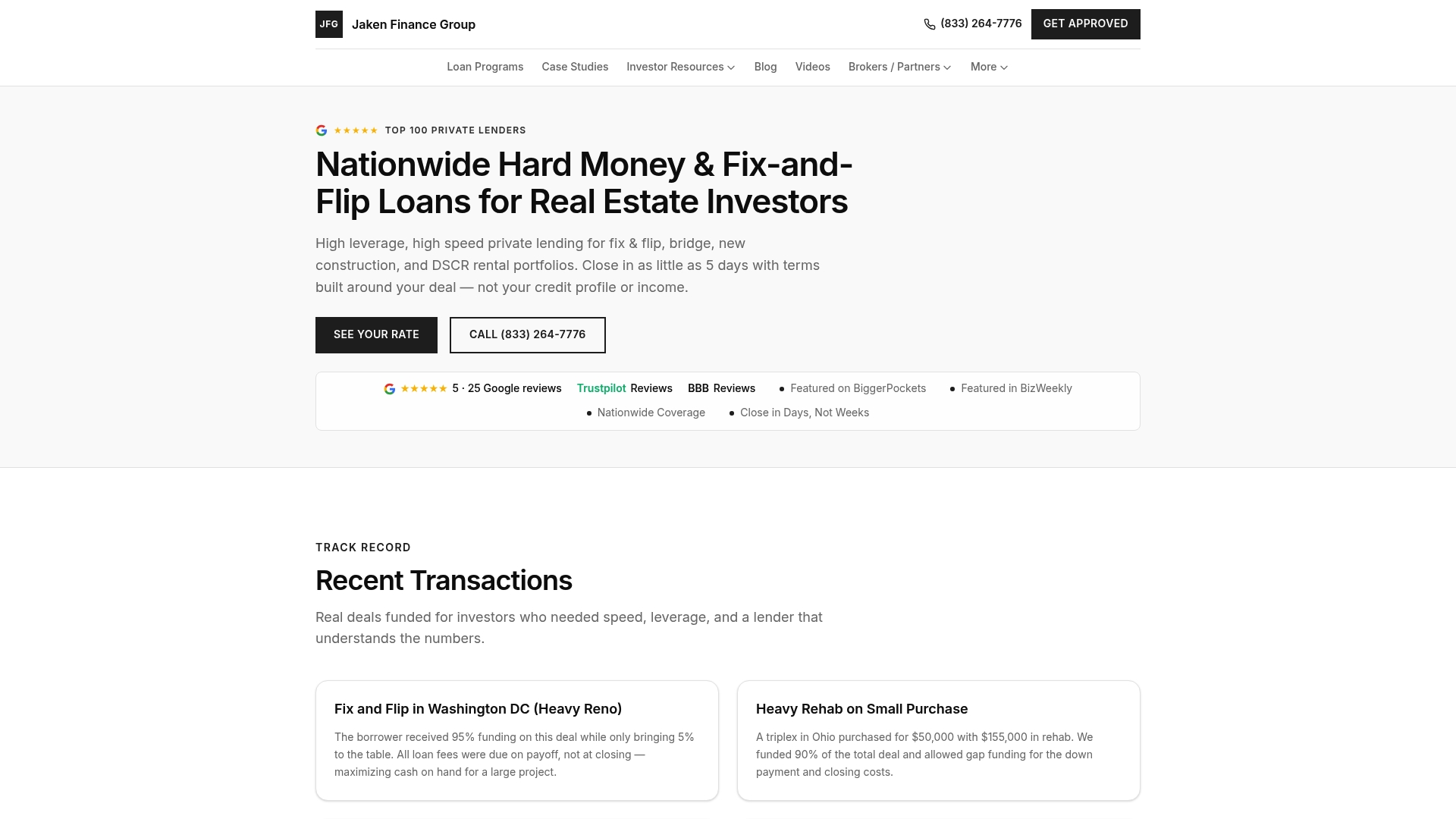
Jaken Finance Group provides hard money, fix-and-flip, bridge, new construction, DSCR rental, and gap loans nationwide, with closings in as few as five days. For investors executing BRRRR strategies who need to exit a hard money loan into DSCR financing quickly, or for those with credit profiles that fall outside standard Non-QM matrices, that speed and flexibility translate directly into deal execution. The BRRRR case study on the Jaken Finance Group website illustrates how the hard-money-to-DSCR transition works in practice.
Investors ready to structure a DSCR cash-out refinance or explore asset-based loan options can start at Jaken Finance Group.
Key Takeaways
A DSCR cash out refinance qualifies on rental income alone, making it the primary equity-extraction tool for investors who cannot or choose not to document personal income.
| Point | Details |
|---|---|
| Standard LTV ceiling | Most lenders cap DSCR cash-out at 75% LTV; 80% is available on strong-credit files (740+ FICO). |
| Seasoning requirement | Ownership of 3–6 months is required before lenders apply the new appraised value for cash-out. |
| Tax treatment | Cash-out proceeds are not taxable income; the IRS treats loan proceeds as debt, not realized gain. |
| Lender specialization matters | Acra Lending suits non-traditional income borrowers; DSCR Loan Funder LLC suits LLC investors needing no-doc loans up to $2 million. |
| Jaken Finance Group | Offers asset-based DSCR and hard money loans nationwide with closings in as few as five days, no minimum credit score required. |