
A direct lender funds your mortgage directly from its own capital, while a mortgage broker shops multiple lenders on your behalf. The Consumer Financial Protection Bureau recommends requesting at least three Loan Estimates before deciding, since homebuyers can potentially save $600 to $1,200 per year by comparing offers. For real estate investors, direct asset-based lenders like Jaken Finance Group offer a third path built around speed and property value rather than credit scores.
TL;DR:
- Request at least three Loan Estimates for the same loan type and terms; compare fees, points, closing costs, and lender credits, not rates alone.
- Check a broker's NMLS license, lender panel breadth, and compensation method; restricted access may omit competitive offers, and pay cannot depend on loan terms.
- Brokers can match borrowers with irregular income or credit blemishes to suitable lenders; clean documentation or a direct bridge loan may favor applying directly.
- Investors facing renovation or construction deadlines should check whether a direct lender bases approval on property value, its realistic closing time, and itemized fees.
- Applying for preapproval with several lenders within a short period should not have a major effect on your credit score.
Table of Contents
- What is a direct lender and how do they operate?
- What does a mortgage broker do and when do they add value?
- Comparing loan options, rates, underwriting, and speed
- How to compare Loan Estimates and negotiate a better deal
- Which borrowers do better with a broker versus going direct?
- How brokers get paid and what protects you from steering
- A decision checklist before you commit to either route
- An investor's view on timing the broker versus direct decision
- Why investors consider Jaken Finance Group as a direct-lending option
- FAQ
- Sources
What is a direct lender and how do they operate?
A direct lender originates and funds loans, then services the loan or sells it after closing. Borrowers deal with the lender's underwriting team and guidelines from application through closing.
Direct lenders include traditional banks, credit unions, online nonbank lenders, and private or hard-money asset-based lenders. Each operates under its own product menu, so the options available to you depend entirely on which direct lender you approach.
The appeal of going direct is a streamlined process. In-house underwriting can mean fewer handoffs and faster decisions, and some direct lenders offer proprietary products unavailable through any broker. For borrowers with straightforward financial profiles or a strong existing banking relationship, this can be the simpler route. For investors who need an asset-based loan closed quickly, a direct hard-money lender skips the layer of broker negotiation entirely.

What does a mortgage broker do and when do they add value?
A mortgage broker acts as an intermediary, submitting your application to multiple lenders and presenting the loan options that come back. Brokers don't fund loans themselves; they match borrowers with lenders willing to approve the file.

Not all brokers have equal reach. A whole-of-market broker can access most of the lending market, while a restricted broker works only with a specific panel of lenders and may not surface the most competitive rate or product for your situation, according to Experian. Verifying a broker's licensing and panel breadth through NMLS before engaging one is a reasonable first step.
Brokers can earn their value by comparing lender options, handling paperwork, negotiating terms, and matching nonstandard borrowers such as the self-employed or those with credit blemishes to lenders willing to underwrite their situation.
Comparing loan options, rates, underwriting, and speed
The practical gap between a broker and a direct lender shows up in four places: how many products you can access, what the loan actually costs, how flexible underwriting is, and how fast you close.
- Product range: brokers typically access multiple lenders' offerings, while a direct lender shows you only its own menu, though some products exist only through direct-only arrangements.
- Headline rate versus total cost: the interest rate alone is incomplete. Origination fees, discount points, and closing costs determine the real cost of the loan, which is why the Loan Estimate exists as a standardized disclosure.
- Underwriting flexibility: brokers can route nonstandard files, like irregular income or lower credit scores, to lenders whose guidelines fit, where a single direct lender might simply decline.
- Closing speed: a direct lender with in-house underwriting can sometimes move faster since there's no extra submission step, though this varies by lender and loan type.
Homebuyers can potentially save $600 to $1,200 per year by comparing offers from multiple lenders rather than accepting the first quote, according to the CFPB. That gap typically comes from fee differences and rate spreads that aren't visible until you line up Loan Estimates side by side. For investors evaluating hard money or bridge financing, the same principle applies: reviewing a loan fees schedule before committing shows where origination points and closing costs diverge between lenders.
How to compare Loan Estimates and negotiate a better deal
Every Loan Estimate breaks down origination charges, third-party services, and any lender credits, and the CFPB treats these sections as the ones worth scrutinizing most closely, since they reflect what the lender or broker controls directly.
- Request Loan Estimates from multiple sources for the same loan type and program so the comparison is apples to apples.
- Align the loan terms (rate lock period, loan amount, product type) across the offers before comparing numbers.
- Add up total costs, not just the interest rate, including origination fees, points, and closing costs.
- Flag any fee that differs sharply between lenders and ask why, since lender-controlled charges should be fairly consistent for similar borrowers.
- Present competing Loan Estimates to your preferred lender and ask them to match or beat the terms; the CFPB notes that shopping multiple offers is itself a negotiating tool.
Some line items, like property taxes and homeowners insurance, sit outside any lender's control and will look similar across offers. When they don't, that's worth a direct question rather than an assumption.
Pro Tip: Get preapprovals from multiple lenders within a short timeframe; shopping for mortgages in a focused timeframe should not majorly impact your credit score.
Which borrowers do better with a broker versus going direct?
The right route often depends on how standard your financial profile is and how much speed you need.
- A broker tends to help most if you're self-employed, have irregular income, carry credit blemishes, or need a specialty program that not every lender offers.
- Going direct tends to work well when your documentation is clean, you have an existing banking relationship, or you need a fast closing on a direct-only product like a hard-money or bridge loan.
- A hybrid approach, using a broker's market sweep while checking a direct lender yourself, can help you assess whether the broker's quotes are competitive.
Investors financing a renovation or new construction project often fall into the second category, since timeline usually matters more than shopping a wide panel of conventional lenders.
How brokers get paid and what protects you from steering
Brokers are typically paid either through a lender-paid commission or a borrower-paid fee, and the CFPB's loan originator compensation rule prohibits tying that pay to steering you into a higher rate or less favorable terms. Compensation can't be based on the specific terms of the loan you end up with.
The practical takeaway: ask any broker how they're paid and whether their lender panel is restricted before you rely on their quote as representative of the market.
A decision checklist before you commit to either route
- Request three or more Loan Estimates for the same loan type and compare total cost, not just rate.
- Verify any broker's NMLS license and ask whether their panel is whole-of-market or restricted.
- Confirm the closing timeline each lender or broker can realistically deliver.
- Ask for an itemized fee breakdown, including any lender credits applied.
- For a broker: ask how they're compensated. For a direct lender: ask whether the quoted rate includes all discount points.
An investor's view on timing the broker versus direct decision
For property investors, speed and asset-based underwriting often outweigh shopping the broadest possible lender panel. When a renovation timeline or closing deadline is tight, a direct lender offering leverage based on the property rather than personal credit can be the more practical route.
— Jason Taken
Why investors consider Jaken Finance Group as a direct-lending option
For real estate investors who need asset-based financing rather than a standard mortgage, we offer fix-and-flip, DSCR rental, bridge, and new construction loans directly, with no minimum credit score and underwriting built around the property's value. We structure closings quickly, which matters when a renovation timeline or a competing offer is on the clock.
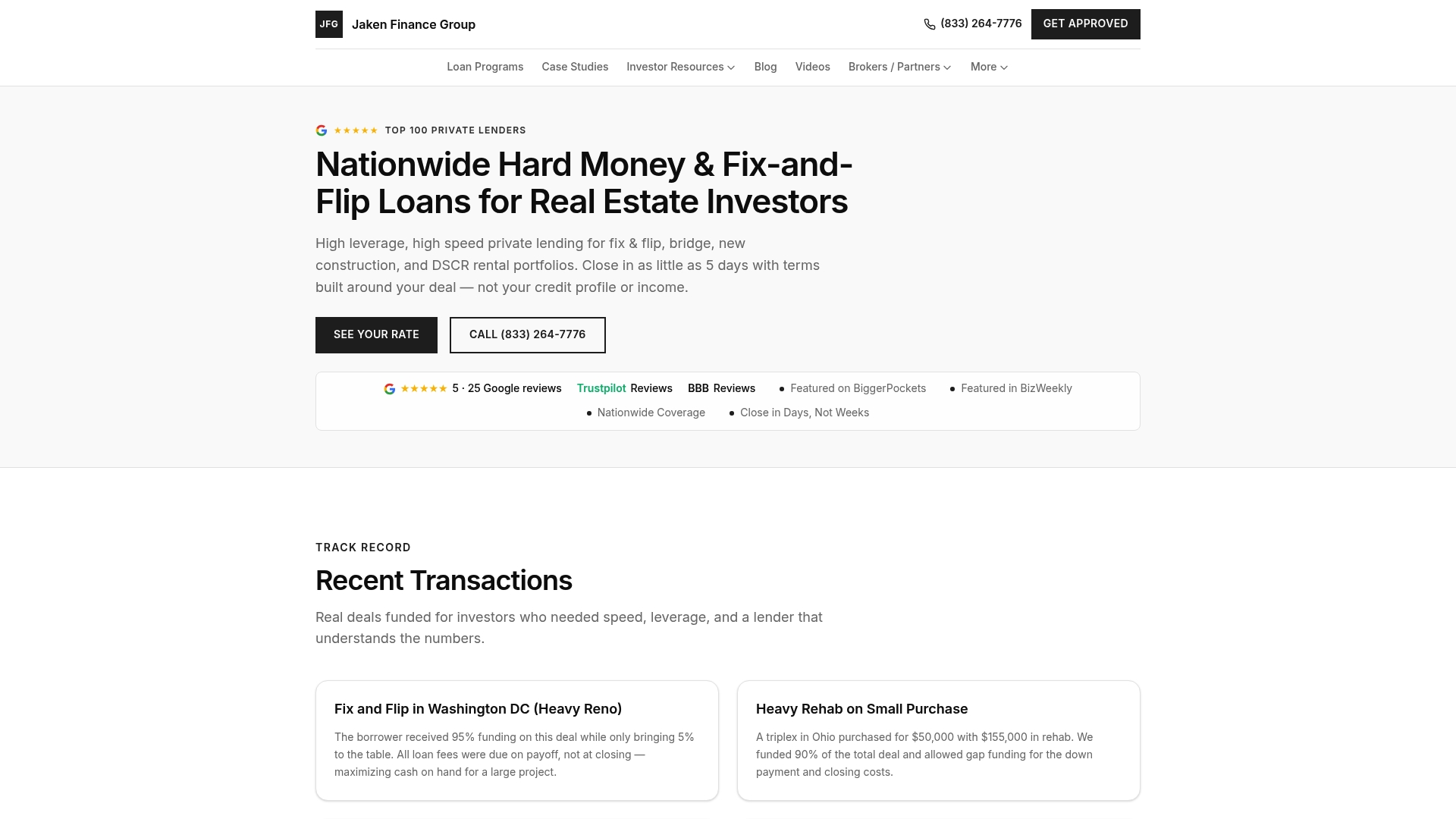
If you're weighing us against another direct lender, check three things: how your project fits our loan programs, how fast we can realistically close your file, and how our points and fees compare against competing quotes. Readers working with a Canadian commercial project can also review brokerage options through WeFinanceU for CMHC-insured and construction financing outside our coverage area.
Explore our fix-and-flip, DSCR rental, and bridge loan options to see current rates and get a quote started.
FAQ
Are mortgage brokers better than lenders?
Neither is universally better; a broker tends to help more with nonstandard credit or income profiles because they can shop multiple lenders, while a direct lender can be simpler or faster for straightforward files. The CFPB recommends shopping around regardless of which route you take.
What is a direct endorsement lender?
A direct endorsement lender is a lender approved by HUD to underwrite and close FHA-insured loans. You can confirm FHA program requirements and lender eligibility details through HUD's FHA resources. You can confirm FHA program requirements and lender eligibility details through HUD's FHA resources.
Is Zillow a mortgage broker?
Zillow operates a marketplace that connects borrowers with multiple lenders and loan officers rather than funding loans itself, which functions similarly to a broker referral service. Always verify the licensing of any individual loan officer you're matched with through NMLS before proceeding.
How does a mortgage broker get paid?
A broker is typically paid through either a lender-paid commission or a fee charged directly to the borrower. Under the CFPB's loan originator compensation rule, that pay cannot be tied to steering you into a higher-rate loan or specific terms.