
Hard money lenders will accept a desktop appraisal for straightforward, data-rich one-unit purchases, but most will not accept one for rehab loans priced off after-repair value or new construction draws. The Appraisal Foundation's USPAP standards permit desktop assignments when the data supports a credible opinion, and Fannie Mae built a formal desktop appraisal product for exactly this reason. Jaken Finance Group underwrites both scenarios differently, and the distinction comes down to two variables.
- Lending purpose: a purchase loan on a conventional property behaves differently than a rehab loan tied to projected ARV.
- Property complexity and LTV: unique properties, low equity cushions, or unverifiable comps almost always push the file toward a hybrid or full interior appraisal.
Key Takeaways
Desktop appraisals speed up hard-money closings on simple, data-rich deals, but rehab and construction loans priced against ARV usually require a hybrid or full interior appraisal to protect both lender and borrower.
| Point | Details |
|---|---|
| Desktop works for simple deals | Conventional one-unit purchases with strong comps and low LTV are the best fit. |
| Rehab and construction need more | ARV-driven and construction loans typically require hybrid or full inspection appraisals. |
| Documentation speeds approval | Dated photos, floor plans, permits, and contractor bids strengthen any desktop file. |
| Costs and speed vary by format | Desktop runs $75 to $200 with fast turnaround; full appraisals cost more and take longer. |
| Missed condition is the core risk | No interior visit means unpermitted work or upgrades can go unrecognized in the value. |
Table of Contents
- What Is a Desktop Appraisal in Hard Money Lending?
- When Will Hard Money Lenders Accept a Desktop Appraisal?
- How Does the Desktop Appraisal Process Actually Work?
- Where Desktop Appraisals Fall Short for Hard-Money Borrowers
- What Do Desktop, Hybrid, and Full Appraisals Cost?
- How Appraisals Shape Hard-Money Loan Terms
- How Jaken Finance Group Evaluates Desktop Appraisals
- Why Desktop Appraisals Get Misapplied in Hard-Money Deals
- Frequently Asked Questions
- Sources
What Is a Desktop Appraisal in Hard Money Lending?
A desktop appraisal is a valuation completed entirely off-site by a licensed appraiser who never sets foot on the property. Instead, the appraiser builds a credible opinion of value from MLS records, public tax data, prior appraisals, satellite imagery, and photos supplied by the borrower or a third party. Done correctly, it can be fully USPAP-compliant under The Appraisal Foundation's guidance, and it's typically the fastest, least expensive format available.
That's different from three related terms investors often confuse:
- Desktop review: an informal internal lender process, not a licensed appraisal product at all.
- Hybrid appraisal: a licensed appraiser analyzes the file remotely while a third-party inspector collects interior and exterior data on-site.
- Full appraisal: the appraiser personally inspects the interior and exterior, then develops the opinion of value.
Some specialized appraisal services deliver desktop reports for as little as $149 with 24-hour turnaround, which explains why the format appeals to lenders moving fast on clean files. Fannie Mae's Form 1004 Desktop formalizes this into a standardized product with its own eligibility and exhibit requirements.
When Will Hard Money Lenders Accept a Desktop Appraisal?
Desktop appraisals fit a narrow band of deals. Understanding where that band starts and ends saves you from a rejected file mid-underwriting.
- Conventional one-unit purchases in data-rich neighborhoods. Suburban tracts with recent, comparable sales give an appraiser enough verified data to trust remotely.
- Low LTV or high-equity transactions. When the loan represents a small slice of the property's value, the lender's downside risk from an imperfect valuation shrinks.
- Portfolio monitoring or refinance checkpoints. Lenders tracking value on an existing asset, rather than committing new capital against unknowns, often accept desktop updates.
- Auction and off-market purchases without interior access. Some auction property purchases close without interior inspection at all, making desktop data the only practical option.
Rehab loans priced against ARV, ground-up construction, and heavily renovated or unique properties almost always require more than a desktop report. Fannie Mae's own guide lists numerous ineligible transaction types for this exact reason: distressed condition, forced upgrades, and construction-in-progress can't be verified from satellite images and tax cards. Loan purpose, not lender preference alone, usually decides the outcome.
How Does the Desktop Appraisal Process Actually Work?
Appraisers working desktop assignments pull from a defined stack of sources: MLS listing history, county tax assessments, prior appraisals on file, satellite and street-view imagery, floor plans, permit records, and any photos the borrower or listing agent provides. Automated valuation models (AVMs) sometimes support the analysis but never substitute for the appraiser's independent judgment under USPAP.
Fannie Mae and industry guidance are specific about what counts as acceptable third-party evidence. Floor plans and verified photos are common exhibits; if that documentation is missing or unreliable, the desktop format shouldn't be used at all.
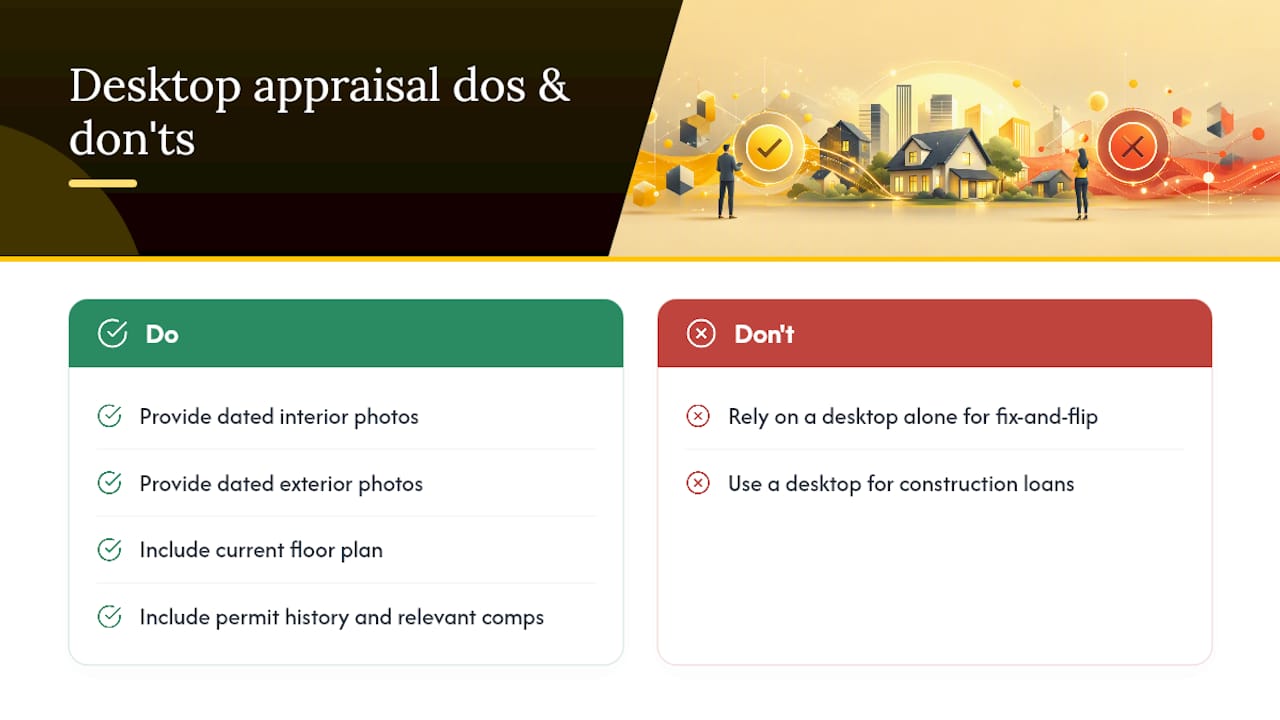
Investors who want a smoother desktop assignment should have ready:
- Recent, dated interior and exterior photos
- A current floor plan or square footage documentation
- Permit history for any recent work
- Contractor bids if renovations are planned or completed
- A short list of comparable sales the appraiser may not surface independently
Pro Tip: Timestamp your photos and save the metadata. Appraisers and lenders both want proof the images reflect current condition, not a listing photo from three years ago.
Where Desktop Appraisals Fall Short for Hard-Money Borrowers
The core risk is simple: an appraiser who never walks the property can't see what changed inside it. Unpermitted additions, deferred maintenance, water damage, or a fully renovated kitchen all sit invisible behind a facade that looks identical in satellite imagery. McKissock's guidance for appraisers is blunt about this gap.
Desktop appraisals are efficient for cookie-cutter homes with strong data, but they can miss recent high-end upgrades entirely. Investors who lean on a desktop valuation for a heavily renovated property risk leaving real equity unrecognized in the appraisal.
For hard-money borrowers, the practical consequences include overfunding against a value that doesn't hold up, ARV expectations that collapse once a supplemental interior inspection happens, or frozen draw requests while the lender orders a full appraisal mid-project. Volatile markets with thin comparable data trigger the same escalation, regardless of property condition.
What Do Desktop, Hybrid, and Full Appraisals Cost?
Desktop appraisals typically run $75 to $200, with some specialist services pricing at $149 and delivering within 24 hours. Turnaround on a clean desktop file often runs same-day to 48 hours. Hybrid appraisals cost more because they add a third-party inspection fee on top of the appraiser's analysis, and full appraisals, which require the appraiser's own site visit, generally take several days to a week and command the highest fee. Specialist appraisers who handle construction-in-progress or as-completed ARV valuations charge a premium and take longer, since construction appraisal work requires reading plans and contractor budgets, not just comparing sales.
How Appraisals Shape Hard-Money Loan Terms
The appraisal format directly shapes how much a lender will fund and how the money gets released. As-is value sets the baseline for LTV on a purchase; ARV sets the ceiling on total loan proceeds for a rehab deal, and the gap between the two often defines the LTC (loan-to-cost) the lender will offer.
- As-is value typically governs initial advance rates on straightforward purchases.
- ARV drives maximum loan amount on fix-and-flip financing, where the lender is betting on post-renovation value.
- Draw schedules and holdbacks during rehab are usually tied to inspection milestones, not the original appraisal alone.
- Documentation for desktop-derived ARV usually includes contractor bids, scope-of-work, permits, and staged photos showing planned or completed upgrades.
A construction oversight partner like Auben Realty's project management services can help investors document that scope of work in a form appraisers and lenders both trust.
How Jaken Finance Group Evaluates Desktop Appraisals
Jaken Finance Group underwrites on asset value and speed, which means a desktop appraisal can work when the deal itself is low-complexity: a straightforward purchase, strong comparable data, and no reliance on projected renovation value. For rehab and construction financing, we typically ask for more than a remote data pull before committing to ARV-based terms.
Files move faster when borrowers arrive with:
- Interior and exterior photos dated within the last 30 days
- A current floor plan
- Contractor bids and a written scope of work
- Permit records for completed or planned improvements
Pro Tip: Submit your documentation package before the appraisal is even ordered. It cuts days off the underwriting timeline and often determines whether a desktop format will suffice.
Why Desktop Appraisals Get Misapplied in Hard-Money Deals
The conventional advice treats desktop appraisals as a simple speed hack: order one, save money, close faster. That advice holds up for a clean purchase and falls apart the moment ARV enters the conversation. The research is consistent on this point: appraisers themselves warn that desktop reports miss what they can't see, and what they can't see is exactly what determines whether a rehab budget makes sense.
The bigger mistake borrowers make is treating appraisal format as a lender preference rather than a function of property risk. It isn't. A lender who accepts desktop appraisals on purchases isn't being inconsistent by requiring a full inspection on a gut renovation. They're responding to a different risk profile entirely.
If you take one thing from this, prioritize documentation over speed shortcuts. A borrower who shows up with photos, permits, and contractor bids often gets a faster decision than one who's simply hoping the desktop format applies.
Frequently Asked Questions
Does a desktop appraisal work for a hard money fix-and-flip loan? Rarely on its own. Fix-and-flip financing is priced against ARV, and most lenders require a hybrid or full interior appraisal to verify renovation scope and post-repair value.
How long does a desktop appraisal take compared to a full appraisal? Desktop appraisals often complete in same-day to 48 hours. Full appraisals, which require an in-person inspection, typically take several days to a week depending on appraiser availability.
What documents should I prepare before requesting a desktop appraisal? Dated interior and exterior photos, a current floor plan, permit history, and comparable sales you believe are relevant all help the appraiser build a credible remote valuation.
Can a desktop appraisal be used for construction loans? Generally no. Construction and as-completed valuations require appraisers experienced in reading plans and contractor budgets, which falls outside a standard desktop assignment.
Ready to find out whether your deal qualifies for a desktop appraisal or needs a fuller valuation? Explore Jaken Finance Group's 100% fix-and-flip financing requirements to see how appraisal format factors into approval and speed.
Sources
- The Appraisal Foundation — USPAP / guidance
- Fannie Mae Selling Guide — Desktop appraisals (Form 1004 Desktop)