
Capitalizing interest on a flip adds borrowing costs to the property's cost basis rather than deducting them immediately, meaning those costs are recovered at sale through cost of goods sold rather than as a current-period expense. Per capitalized interest accounting rules, this shifts the tax deduction from the active project period to the disposition event. Three immediate investor impacts follow:
- Cash flow vs. reported expenses: Interest still consumes cash each month, but capitalization removes it from your current income statement, which can improve reported operating margins during the rehab period.
- Taxable basis and gain timing: Capitalized interest increases the property's adjusted basis, which reduces taxable gain at sale rather than reducing ordinary income during the hold period.
- Documentation requirements: Your CPA and lender both need dated draw schedules, interest accrual ledgers, and promissory notes to substantiate the capitalized amounts under audit.
The governing rules are IRC 263A(f) and Treas. Reg. 1.263A-9 on the tax side and ASC 835-20 on the accounting side. Consult your CPA before changing your accounting method on any active project.
Pro Tip: Bring your loan's draw schedule and interest accrual ledger to your first CPA meeting on any flip. Without those documents, your CPA cannot determine which interest amounts are capitalizable under the avoided-cost method.
Key Takeaways
Capitalizing interest on a fix-and-flip increases the property's cost basis rather than reducing current income, so the tax benefit is deferred to the sale event rather than realized during the hold period.
| Point | Details |
|---|---|
| Capitalization adds to basis | Interest is recovered through cost of goods sold at sale, not as a current deduction. |
| Avoided-cost method governs | Trace debt first, then apply the weighted-average rate to excess expenditures per Treas. Reg. 1.263A-9. |
| Small-business exception exists | Entities with average gross receipts under approximately $25 million may qualify to expense rather than capitalize. |
| Accrual date controls timing | Lender payment structures (reserves, deferred interest) do not change the capitalization computation period. |
| Jaken Finance Group financing | Jaken Finance Group provides fix-and-flip loans with draw schedules and interest accrual documentation that support the avoided-cost computation your CPA needs. |
Table of Contents
- What capitalizing interest actually means for a flip: accounting vs. tax rules
- When to start and stop capitalizing interest on a fix-and-flip
- How to compute capitalizable interest using the avoided-cost method
- Practical impacts on cash flow, margins, and taxable gain timing
- How lenders structure flip loan interest and what that means for capitalization
- Decision checklist: when to capitalize, when to expense, and what to ask
- A lender's perspective on documentation and deal clarity
- Financing your next flip with Jaken Finance Group
- Sources
What capitalizing interest actually means for a flip: accounting vs. tax rules
The term "capitalized interest" describes the same economic event from two regulatory frameworks, and flippers need to understand both.
Under ASC 835-20, the objective is matching: interest cost is added to the asset's carrying value so the expense is recognized in the same period the asset generates revenue. On a GAAP financial statement, capitalized interest appears on the balance sheet as part of the project's cost, not on the income statement as an interest expense line.
IRC 263A(f) operates differently. It mandates capitalization for "designated property" produced by the taxpayer, which includes real property constructed or substantially improved for sale. The mechanics use the avoided-cost method under Treas. Reg. 1.263A-9 rather than a simple matching principle.
| Dimension | ASC 835-20 (Accounting) | IRC 263A(f) / Treas. Reg. 1.263A-9 (Tax) |
|---|---|---|
| Rule reference | FASB ASC 835-20 | IRC 263A(f); Treas. Reg. 1.263A-9 |
| When it applies | Asset being readied for intended use | Production period for designated property |
| Measurement basis | Actual interest on qualifying expenditures | Avoided-cost method (traced debt + excess expenditure) |
| Flip implication | Improves reported margins during rehab | Increases tax basis; deduction deferred to sale |
The practical gap: your GAAP books and your tax return may show different capitalized interest amounts because the measurement methods differ. Your CPA reconciles those differences at year-end.
When to start and stop capitalizing interest on a fix-and-flip
Capitalization begins when production expenditures start and qualifying activities to ready the property are ongoing. It stops when the asset is substantially complete or when activities are intentionally suspended.
Under ASC 835-20, "substantially complete" means the asset is ready for its intended use, not necessarily that every punch-list item is finished. If you pause rehab work intentionally for more than a brief period, capitalization stops during the suspension. Under Treas. Reg. 1.263A-9, the computation period runs from the date production expenditures first occur through the end of the production period, with specific measurement-date rules for each computation period.
Key start/stop checkpoints for flippers:
- Start: First draw on the rehab loan or first qualifying expenditure on the property, whichever comes first.
- Continue: While active construction, renovation, or permitting activities are ongoing.
- Suspend: If work stops intentionally for a period beyond brief interruptions; capitalization pauses.
- Stop: When the property is substantially complete and ready for sale.
- Exception: Small-business taxpayers with average annual gross receipts under approximately $25 million (adjusted for inflation) may qualify for relief from Section 263A capitalization requirements.
- Method change: Switching to or from capitalization typically requires filing Form 3115 with the IRS.
Pro Tip: Document the date of your first rehab expenditure and the date of substantial completion in your project ledger. Those two dates define your capitalization window and are the first thing an IRS examiner will request.
How to compute capitalizable interest using the avoided-cost method
The avoided-cost method under Treas. Reg. 1.263A-9 requires tracing debt directly to the project first, then computing excess expenditure amounts and applying a weighted-average rate to any remainder. The IRS practice unit formalizes this as Sub-steps A through E.
Sub-steps A–E:
- Identify eligible debt: All debt outstanding during the computation period.
- Compute traced debt amount: The portion of debt directly traceable to production expenditures on this property.
- Compute excess expenditure amount: Total accumulated production expenditures minus the traced debt amount; this is the amount subject to the weighted-average rate.
- Compute total interest available: Sum of all interest incurred on eligible debt during the period.
- Allocate and prorate: Traced debt interest is capitalized first; excess expenditure amount is multiplied by the weighted-average interest rate on remaining debt and that product is also capitalized.
Worked example:
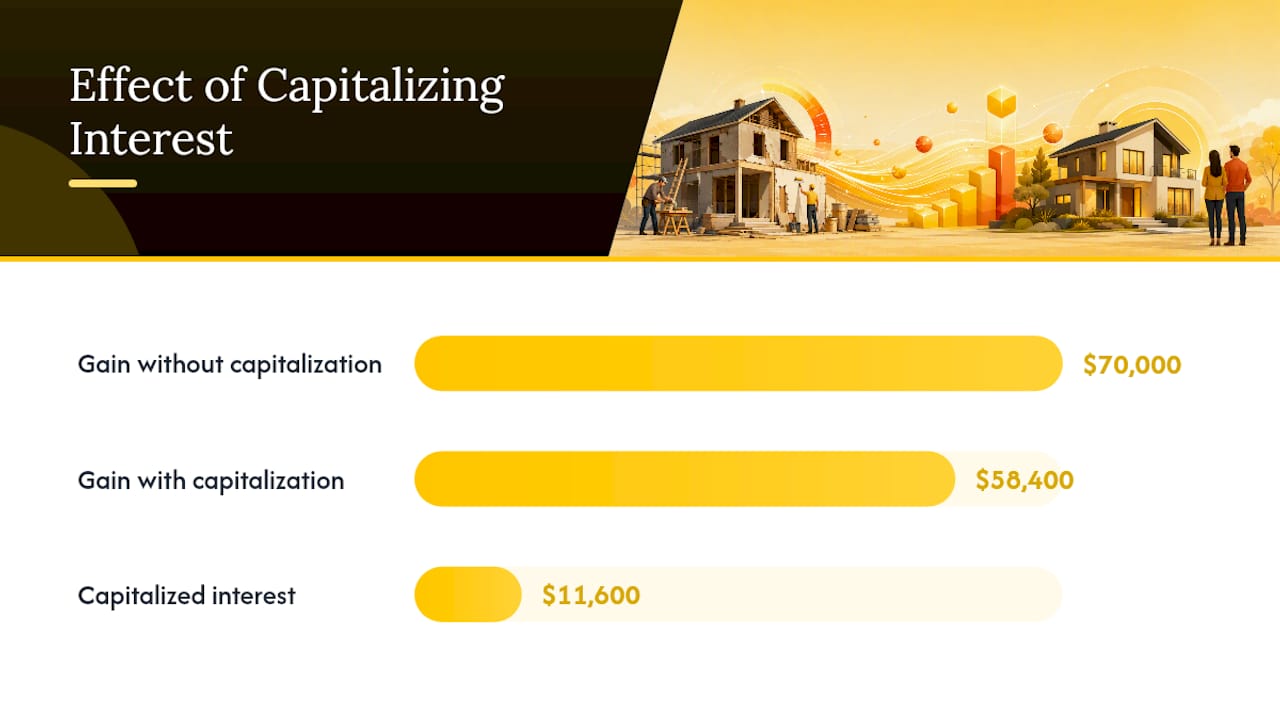
That $11,600 is added to the property's cost basis rather than deducted as interest expense. If the property sells for $310,000 with a total basis of $251,600 ($240,000 + $11,600), taxable gain is $58,400. Without capitalization, the gain would have been $70,000 but the investor would have deducted $11,600 of interest during the hold period. Use a loan amortization calculator to convert your draw schedule into period-by-period interest accruals before running this computation.
Pro Tip: Build a simple spreadsheet with one row per draw date, the cumulative expenditure balance, and the interest accrued. That single document satisfies both the traced-debt and excess-expenditure calculations and gives your CPA a clean audit trail.
Practical impacts on cash flow, margins, and taxable gain timing
Capitalization defers expense recognition, which can improve reported operating margins during the rehab period but shifts the tax recognition event to sale or basis recovery. The cash outflow is identical either way; only the timing of the tax deduction changes.
On a six-month flip with $11,600 of capitalizable interest, expensing that interest immediately reduces ordinary income by $11,600 in the current period. Capitalizing it instead adds $11,600 to basis, reducing capital gain at sale. For a flipper taxed at ordinary income rates on short-term gains, the total tax liability may be similar, but the timing and the character of the deduction differ. Your CPA should model both scenarios before you close the loan.
Reporting implications to track:
- Basis increases must be documented and reconciled to the final HUD-1 or closing disclosure at sale.
- Capitalized interest is recovered through cost of goods sold on Schedule C or Form 1065, not as a separate interest deduction.
- Section 163(j) limits business interest deductions, but interest capitalized under 263A(f) is removed from the 163(j) calculation entirely, which can be a meaningful planning advantage for highly leveraged flips.
- Section 266 offers elective capitalization for carrying charges, but it is subordinate to mandatory 263A(f) capitalization; model both before electing.
How lenders structure flip loan interest and what that means for capitalization
Lenders often advance rehab draws in tranches and may build an interest reserve into the loan or allow interest to be deferred and rolled into the payoff balance. Those structures change when cash changes hands but do not change whether interest is capitalizable under the tax rules. Tracking accrual dates versus payment dates is the critical distinction.
| Lender Feature | How It Works | Capitalization Implication |
|---|---|---|
| Interest reserve | Lender withholds a portion of loan proceeds to cover monthly interest payments | Interest is still accruing; capitalization runs from first draw regardless |
| Deferred/rolled interest | Interest accrues and is paid at balloon payoff | Accrual date, not payment date, governs the computation period |
| Draw schedule | Rehab funds released in stages tied to inspections | Each draw increases accumulated production expenditures; update traced debt monthly |
| Origination points | Paid at closing; may be deductible or amortizable separately | Points are generally not capitalizable interest; confirm treatment with CPA |
Hard-money and short-term flip loans commonly carry rates in the 8–12% range or higher, which makes the capitalized interest amount material on most projects. Documents your CPA needs from the lender:
- Promissory note with rate, term, and draw conditions
- Dated draw schedule with amounts and disbursement dates
- Interest reserve accounting or accrual ledger
- Form 1098 or lender-issued interest statement
- Use-of-proceeds language confirming funds applied to the subject property
For more on how hard-money loan structures affect flip economics, including LTV caps and draw timing, review Jaken Finance Group's lending overview.
Decision checklist: when to capitalize, when to expense, and what to ask
Decide based on four factors: production period length, materiality of interest, entity gross receipts, and lender payment structure.
Capitalize if:
- The production period exceeds a few months and interest is material relative to project cost.
- The entity does not qualify for the small-business gross receipts exception (average annual gross receipts at or above approximately $25 million).
- The loan proceeds are traceable to the subject property.
Consider expensing if:
- The small-business exception applies and your CPA confirms no Form 3115 is required.
- Interest is immaterial relative to total project cost.
Questions to ask your CPA:
- Does IRC 263A(f) apply to this unit of property given our entity structure and gross receipts?
- Should we elect a change of accounting method via Form 3115, and what is the cut-off date?
- How does Section 163(j) interact with our capitalized interest on this project?
- Should we consider Section 266 elective capitalization for any carrying charges not covered by 263A?
Questions to ask your lender:
- Does the loan include an interest reserve or deferred interest? Provide the draw schedule and interest accrual ledger.
- Are origination points included in the loan balance or paid separately at closing?
- Will you provide a monthly interest accrual statement, not just a payment history?
Red flags requiring immediate CPA escalation:
- Loan proceeds used for multiple properties without separate accounting.
- No draw documentation or lender ledger available.
- Interest not recorded separately from principal in the loan servicer's records.
A lender's perspective on documentation and deal clarity
From Jaken Finance Group's position as a direct lender on fix-and-flip projects, clear interest documentation is not a back-office detail. It affects closing speed, draw approval timelines, and the investor's ability to substantiate basis at sale. Lenders who see well-organized draw schedules and interest accrual ledgers can process subsequent draws faster because the use-of-proceeds trail is already established.
Pro Tip: Maintain a single project ledger with columns for draw date, draw amount, cumulative expenditures, interest accrued for the period, and cumulative capitalized interest. Share an updated version with your CPA monthly and with your lender at each draw request. That one document satisfies audit documentation, supports the avoided-cost computation, and speeds lender draw approvals simultaneously.
Financing your next flip with Jaken Finance Group
Fix-and-flip investors who understand interest capitalization need a lender whose loan structure supports clean accounting, not one that complicates it.

Jaken Finance Group provides 100% fix-and-flip financing with asset-based underwriting, no minimum credit score requirement, and closings in as few as five days. Loan structures include detailed draw schedules and interest accrual documentation, giving your CPA exactly the records needed to run the avoided-cost computation accurately. Because underwriting focuses on the property's value rather than borrower credit history, investors with varying financial profiles can access the leverage they need without the delays of conventional lending. Use the compound interest calculator to model your capitalized interest before your first CPA meeting, then contact Jaken Finance Group to structure the loan around your project timeline and basis targets.
This article provides general educational information about interest capitalization rules and is not a substitute for advice from a qualified CPA or tax attorney. Confirm current IRS regulations and your entity's specific treatment with a licensed tax professional before changing your accounting method.
Sources
Bring these primary sources to your CPA meeting to verify the rules and confirm your entity's treatment:
- 26 CFR § 1.263A-9 - The avoided cost method.
- Interest capitalization practice unit (IRS)
- What Is Capitalized Interest?
- Real Estate Development – When to Expense vs. Capitalize Costs - Withum