
Cap rate measures an asset's unlevered return; DSCR measures whether that asset's income will cover a loan. Run DSCR first to confirm loan feasibility, then use cap rate to judge valuation and market fit. Morgan](https://www.jpmorgan.com/insights/real-estate/commercial-term-lending/what-is-debt-service-coverage-ratio-dscr-in-real-estate). Conventional lenders typically require DSCR between 1.15 and 1.35, with 1.25 as the most common bankable benchmark. Cap rates, as Investopedia notes, generally range from 4% to 10% depending on market and asset class, with most stabilized markets landing between 5% and 8%.
The practical sequence: if DSCR fails at the proposed loan terms, restructure financing or walk away before you spend time on valuation. If DSCR clears but the cap rate looks weak against local comps, renegotiate the purchase price or pass. Both checks are necessary; neither alone is sufficient.
Key Takeaways
Cap rate and DSCR answer different questions; running them in the right sequence prevents both bad loans and bad deals.
| Point | Details |
|---|---|
| Run DSCR first | Check loan feasibility before valuation; a failing DSCR at proposed terms ends the analysis early. |
| DSCR thresholds to know | 1.25 is the standard bankable benchmark; most lenders require 1.15–1.35 minimum. |
| Cap rate benchmarks | 4%–10% by market; stabilized assets in most U.S. markets fall between 5% and 8%. |
| Negative leverage warning | When the mortgage rate exceeds the cap rate, every leveraged dollar costs more than the property earns. |
| Jaken Finance Group | Offers DSCR loans, hard money, and bridge products for investors whose deals need flexible or asset-based underwriting. |
Table of Contents
- How Cap Rate and DSCR Are Defined and Calculated
- Cap Rate vs. DSCR: What Each Metric Actually Answers
- Worked Examples: Same Cap Rate, Different DSCR
- How Lenders Use DSCR and Cap Rate in Underwriting
- How to Use Cap Rate and DSCR Together Before You Bid
- When Cap Rate and DSCR Can Mislead You
- Quick-Reference Formulas and Rules of Thumb
- An Asset-Based Lender's Perspective on These Metrics
- Flexible Financing for Investors Who Need More Than a Formula
- Sources
How Cap Rate and DSCR Are Defined and Calculated
The formulas
Cap rate = NOI ÷ Property Value × 100
DSCR = Annual NOI ÷ Annual Debt Service
Both formulas hinge on net operating income (NOI), so calculating it accurately is the first task in any underwriting sequence.
How to calculate NOI
NOI is gross scheduled income, adjusted for vacancy, plus any ancillary income, minus all operating expenses. Typical operating expenses include:
- Property management fees
- Maintenance and repairs
- Property taxes
- Insurance
- Utilities (when owner-paid)
- Reserves for replacement (often 5%–10% of gross rents)
Two items are explicitly excluded from NOI: debt service and depreciation. Including either distorts both metrics.
How to calculate annual debt service
Annual debt service equals the total of 12 monthly principal-and-interest payments. Shorten the amortization to 20 years and that figure rises to approximately $67,200. The loan terms, not the property, drive this number, which is why the same property can produce a passing or failing DSCR depending entirely on how it is financed.
Pro Tip: Lenders distinguish between trailing NOI (last 12 months of actuals) and stabilized NOI (a forward-looking figure adjusted for occupancy and market rents). Most conventional lenders underwrite to trailing NOI; some DSCR loan products accept stabilized NOI with documented support. Common add-backs lenders scrutinize include one-time repair costs, owner-paid utilities that tenants will assume, and short-term vacancy from a recent turnover. Confirm which NOI figure your lender accepts before running your DSCR calculation, as the difference can move the ratio by 0.10–0.20 points. See HonestCasa's breakdown for a practical overview of how lenders handle NOI timing choices.
Cap Rate vs. DSCR: What Each Metric Actually Answers
CapRateCity frames the distinction precisely: cap rate tells an investor how hard a property works as an all-cash purchase; DSCR tells a lender whether the property's income will support the proposed mortgage.
| Dimension | Cap Rate | DSCR |
|---|---|---|
| Question answered | What return does this asset generate, unlevered? | Can this property's income cover its debt payments? |
| Formula | NOI ÷ Property Value | Annual NOI ÷ Annual Debt Service |
| Primary user | Investor (valuation, market comparison) | Lender (loan feasibility, credit decision) |
| Typical benchmarks | 4%–10%; most stabilized markets 5%–8% | 1.15–1.35 minimum; 1.25 common threshold |
| Effect of leverage | Unaffected by financing terms | Directly affected by rate, amortization, LTV |
| When to prioritize | Comparing assets, negotiating price | Qualifying for a loan, stress-testing debt |
A high cap rate does not guarantee a bankable DSCR. Conversely, an excellent DSCR on a low-cap-rate property in a gateway market may reflect aggressive pricing that limits long-term yield. Wikipedia's entry on DSCR confirms that a ratio below 1.0 means NOI does not cover required principal and interest, indicating negative cash flow at the property level.
Lenders will always check DSCR. Investors use cap rate to compare markets and assets. Both perspectives are necessary, but they operate at different stages of the same decision.
Worked Examples: Same Cap Rate, Different DSCR
Only the loan terms change.
The cap rate is identical in both scenarios. The DSCR swings from marginal to failing purely because of rate and amortization differences.
Step-by-step calculation for Scenario A
- Confirm NOI: $60,000 (gross rents $78,000, vacancy 5% = $3,900, operating expenses $14,100).
- Calculate cap rate: $60,000 ÷ $900,000 = 0.0667 = 6.67%.
- Determine loan amount: $900,000 × 75% = $675,000.
- Calculate monthly payment: $675,000 at 6.75% over 30 years ≈ $4,377/month.
- Annual debt service: $4,377 × 12 = $52,524.
- DSCR: $60,000 ÷ $52,524 = 1.14.
- Result: Below the 1.15 minimum most conventional lenders require. Options: increase down payment, negotiate a lower purchase price, or seek a lender with a 1.10 floor.
Scenario C: Same DSCR, different cap rates
Consider two properties, both producing DSCR of 1.28 at identical loan terms.
- Interpretation, Scenario A/B: Identical cap rates mask a financing risk that only DSCR surfaces. Always run both.
- Interpretation, Scenario C: Identical DSCR can mask a valuation premium. Cap rate comparison against local comps is the check that catches it.
How Lenders Use DSCR and Cap Rate in Underwriting
Conventional commercial lenders and most DSCR loan products set minimum DSCR thresholds, typically in the 1.15–1.35 range. The 1.25 level functions as a standard pricing tier: loans clearing 1.25 often qualify for better rates, while loans between 1.15 and 1.25 may carry a rate premium or require additional reserves. Loans above 1.50 DSCR generally access the most favorable pricing. See DSCR loan rates in 2026 for current rate-tier detail.

Non-QM and asset-based lenders sometimes accept DSCR as low as 1.0 or even below 1.0 for short-term bridge or fix-and-flip scenarios, where the exit strategy (sale or refinance) rather than current cash flow drives the credit decision. The DSCR loan requirements guide covers qualification thresholds and documentation in full.
Cap rate enters lender underwriting in two ways. First, lenders use it to validate the appraised value via the income approach: if the appraiser's cap rate assumption is materially lower than market, the lender may challenge the valuation. Second, institutional lenders on larger loans often track debt yield (NOI ÷ loan amount) alongside DSCR. Debt yield is rate-independent, so it remains stable even when interest rates shift. As PrimeCalcTools notes, debt yield provides a lender-focused check that complements DSCR when amortization terms can be structured to hit a ratio target artificially.
Document each add-back with a lease, invoice, or market-rate comparison before submitting to underwriting.
In a higher-rate environment, TrueCap's analysis highlights that negative leverage, where the mortgage rate exceeds the property's cap rate, has become a dominant underwriting risk.
How to Use Cap Rate and DSCR Together Before You Bid
Run these steps in sequence before signing a purchase contract.
- Confirm stabilized NOI. Use trailing actuals adjusted for market vacancy (typically 5%–10%) and normalized operating expenses. Do not use the seller's pro forma without independent verification.
- Run DSCR at proposed loan terms. Calculate annual debt service at your expected rate and amortization. If DSCR falls below 1.15, the deal does not pencil at those terms.
- Test alternative loan structures. Model a 5% larger down payment, a 5-year IO period, or a 25-year vs. 30-year amortization. Identify which adjustment, if any, brings DSCR to 1.25 or above.
- Calculate cap rate and compare to local comps. Pull recent sales of comparable properties in the same submarket. If your cap rate is 50–100 basis points below the comp set, the property is priced at a premium that may not be justified.
- Run cash-on-cash and debt yield as tie-breakers. Cash-on-cash (annual pre-tax cash flow ÷ total cash invested) captures the levered return your equity actually earns. Debt yield (NOI ÷ loan amount) provides a rate-independent lender check. Both help resolve close calls.
Sensitivity test template
Before committing, stress-test the deal against two scenarios:
- Rate increase of 1%: Recalculate annual debt service and DSCR. A 1% rate increase on a $700,000 loan adds roughly $4,900 in annual debt service, which can drop DSCR by 0.08–0.12 points.
- NOI decline of 10%: Reduce NOI by 10% (vacancy spike, rent concession, or expense increase) and recalculate DSCR and cap rate. If either metric fails under this scenario, the deal carries meaningful downside risk.
If DSCR fails: Increase equity, negotiate a lower purchase price, extend amortization, or seek a lender with a lower DSCR floor. If none of those options work, pass.
If cap rate is weak: Renegotiate price, identify value-add upside that will raise NOI post-acquisition, or accept that you are paying a premium for a lower-risk asset in a supply-constrained market.
When Cap Rate and DSCR Can Mislead You
Both metrics are only as reliable as the NOI figure behind them. The most common calculation mistakes:
- Using trailing NOI without stabilization adjustments. A property that was 70% occupied for six months of the trailing year will show depressed NOI. Using it raw understates cap rate and overstates DSCR risk on a stabilized asset, or the reverse if occupancy was temporarily inflated.
- Ignoring CAPEX in operating expenses. Roof replacements, HVAC systems, and parking lot resurfacing are real costs. Excluding them from NOI inflates both cap rate and DSCR.
- Relying on advertised rents rather than executed leases. Pro-forma rents that exceed current market rents by 10%–15% are common in seller packages. Verify against active comparable leases.
- Mixing pre-tax and post-tax cash flows. NOI is a pre-tax, pre-financing figure. Introducing tax benefits or depreciation into the NOI calculation corrupts both metrics.
- Ignoring one-time income items. A lease termination fee or insurance settlement in the trailing period inflates NOI. Strip it out before underwriting.
Wikipedia's capitalization rate entry notes that cap rate is an unlevered measure that ignores financing entirely, which means it cannot signal whether a leveraged purchase will cash-flow. That limitation is precisely why DSCR exists as a separate check.
Negative leverage deserves specific attention. When the mortgage rate exceeds the cap rate, borrowed capital costs more than the property earns on that capital. The result: every additional dollar of debt reduces cash-on-cash return. The deal may still make sense if appreciation or value-add upside compensates, but the cash flow math will not work in the investor's favor from day one.
Pro Tip: Always re-run DSCR for the refinance scenario at loan maturity. Model the exit before you model the entry.
Quick-Reference Formulas and Rules of Thumb
- Cap rate: NOI ÷ Property Value × 100 (expressed as a percentage)
- DSCR: Annual NOI ÷ Annual Debt Service (expressed as a ratio)
- Debt yield: NOI ÷ Loan Amount × 100 (rate-independent lender check)
- Cash-on-cash return: Annual Pre-Tax Cash Flow ÷ Total Cash Invested × 100
Rules of thumb to memorize:
- DSCR of 1.25 or above clears most conventional and DSCR loan underwriting.
- DSCR below 1.0 means the property cannot cover its own debt from operations.
- Cap rates of 4%–6% are typical in high-demand, low-risk markets (gateway cities, Class A assets). Cap rates of 7%–10% reflect higher perceived risk or secondary/tertiary markets.
- When the mortgage rate exceeds the cap rate, the deal is in negative leverage territory. Proceed only with a documented value-add or appreciation thesis.
For hands-on modeling, use the DSCR calculator for rental properties to reproduce the worked examples above with your own inputs. Cross-check cap rate calculations using the Tickerplace cap rate formula guide for a practical breakdown of market drivers. Always verify NOI inputs against actual lease documents and expense statements, not seller-provided summaries.
An Asset-Based Lender's Perspective on These Metrics
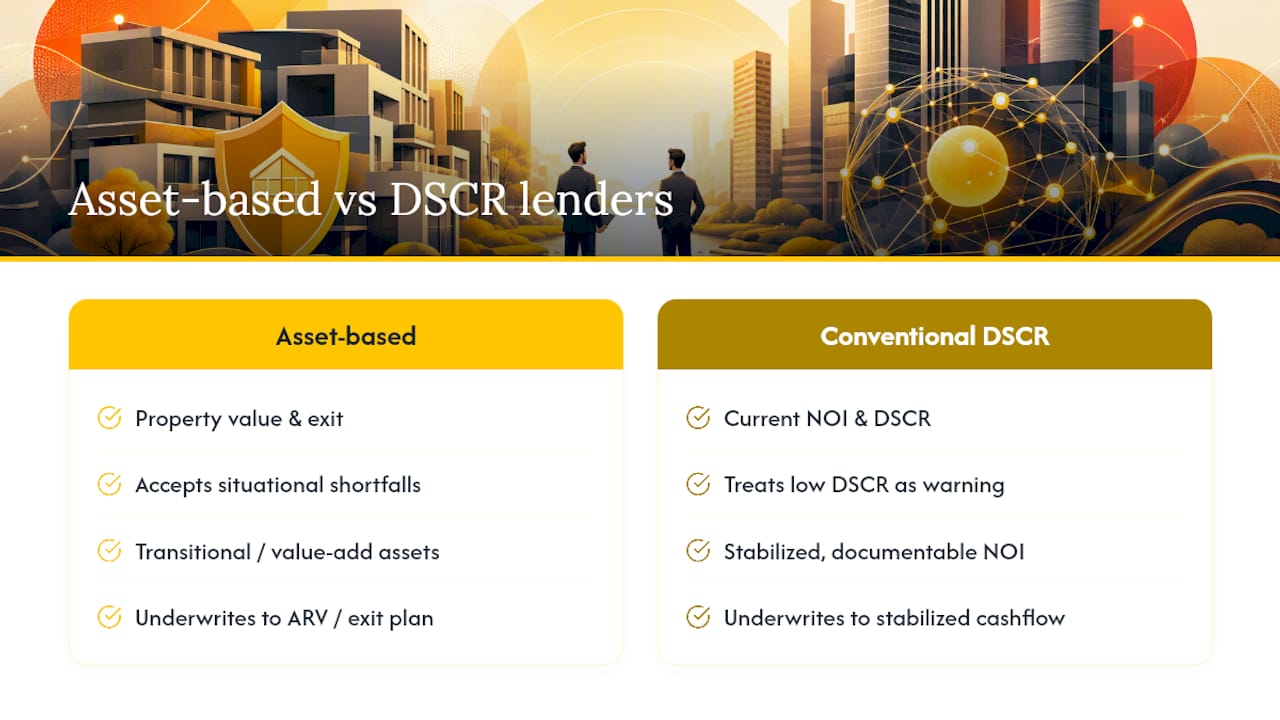
The conventional framing of cap rate vs. DSCR treats both as binary pass/fail gates. In practice, experienced lenders read them as signals that point toward the right structure, not just toward approval or denial.
A property with a 1.10 DSCR is not automatically unfundable. The relevant question is whether the shortfall is structural (the NOI genuinely cannot support the debt) or situational (a lease-up period, a recent renovation, or a temporary vacancy). Asset-based underwriting, which focuses on the property's value and exit strategy rather than current cash flow alone, can accommodate the situational case. A fix-and-flip or bridge loan, for instance, is underwritten to ARV and the exit plan, not to a stabilized DSCR.
The investors who benefit most from asset-based lending are those with strong properties in transitional states: a value-add multifamily mid-renovation, a short-term rental property not yet at stabilized occupancy, or a commercial asset being repositioned. Conventional DSCR loan products work best when the property is already stabilized and the NOI is clean and documentable.
What the metrics do not capture is execution risk. A 1.35 DSCR on a property managed by an inexperienced operator can deteriorate faster than a 1.15 DSCR on a well-run asset. The numbers are the starting point, not the conclusion.
Flexible Financing for Investors Who Need More Than a Formula
Calculating DSCR and cap rate is straightforward. Finding a lender who can close on the deal those calculations identify is a different problem.
Jaken Finance Group offers DSCR rental loans, hard money, fix-and-flip, bridge, and no-ratio DSCR options at 75% LTV for investors whose deals do not fit a conventional underwriting box. Closings in as few as five days, no minimum credit score requirement, and asset-based underwriting mean the property's value and income potential drive the decision, not a rigid DSCR threshold. Whether your deal clears 1.25 DSCR or needs a bridge to stabilization, contact Jaken Finance Group to run a quick scenario on your candidate property and identify the right loan structure before you make an offer.
Sources
The following sources were used to verify formulas, thresholds, and underwriting principles in this article.
- Capitalization rate (cap rate) definition | Investopedia
- Capitalization rate — Wikipedia
- Cap rate vs cash-on-cash vs DSCR: which matters? | TrueCap
- DSCR vs Cap Rate: Two Metrics, Two Purposes | CapRateCity
Cross-check all NOI inputs against executed leases and trailing expense statements. Use stabilized NOI assumptions for cap rate comparisons and confirm with your lender which NOI figure they will underwrite to before submitting a loan application.
This article is general information, not a substitute for advice from a qualified financial advisor. Consult a qualified financial professional about your own circumstances before acting on anything here.