
Which platform wins: Buildium or AppFolio?
Buildium is the stronger choice for small to mid-sized portfolios that prioritize accounting depth, QuickBooks integration, and predictable flat-rate pricing. AppFolio is built for operators managing larger portfolios who need AI-powered leasing automation, a polished mobile experience, and enterprise-grade reporting. The decision is less about which platform is better and more about which one matches your portfolio's current scale and operational complexity.
| Dimension | Buildium Property Management Software | AppFolio, Inc. | Best For |
|---|---|---|---|
| Starting price | — | Minimum $298/month (50-unit minimum) | Buildium for smaller portfolios |
| Pricing model | Flat-rate tiered | Per-unit pricing with minimums | Buildium under 150 units |
| Scalability | Suitable for small to mid-sized portfolios | Designed for larger portfolios | AppFolio at scale |
| Ease of use | Higher; faster onboarding time | Moderate; longer onboarding time | Buildium for fast setup |
| Accounting features | Best-in-class; QuickBooks native | Excellent; AI-enhanced | Buildium for accounting depth |
| Tenant communication | Solid portals; manual leasing | AI leasing assistant (Lisa); automated | AppFolio for high-volume leasing |
| Marketing tools | Zillow, Apartments.com syndication | 30+ ILS platforms; AI lead response | AppFolio for vacancy automation |
| Automation capabilities | Core workflows; API on Premium | AI triage, renewal automation, Realm-X | AppFolio for advanced automation |
| G2/Capterra ratings | 3.6-star average from Google reviews | 3.5-star average from Google reviews | — |
Key suitability points at a glance:
- Buildium suits property managers transitioning from spreadsheets, HOA managers, and portfolios where accounting accuracy and QuickBooks compatibility drive daily operations.
- AppFolio suits growth-stage management companies handling high leasing volume, multi-site portfolios, and teams that need role-based permissions and AI-assisted workflows.
- The cost crossover sits around 150–200 units, where AppFolio's per-unit pricing becomes more competitive relative to Buildium's flat-rate tiers.
What do Buildium and AppFolio actually offer?
Buildium is a verified US platform operating from Boston, MA, built for residential property managers and community association managers. It covers accounting, online rent collection, maintenance tracking, tenant screening via TransUnion, lease management, and owner reporting. The platform carries high ratings on G2, Software Advice, Capterra, and the App Store, and offers a free trial with no credit card required. HOA management is a distinct strength AppFolio does not replicate.
AppFolio, headquartered in Goleta, CA, positions itself as an AI-native real estate performance platform targeting mid-to-large portfolios. Its core differentiators are the AI leasing assistant Lisa, the Realm-X workflow automation engine, mobile-first operations, and support for residential, commercial, student housing, and mixed-use portfolios. A 50-unit minimum applies to all plans.
Buildium primary features:
- Full general ledger accounting with QuickBooks integration and 1099 e-filing
- Tenant and owner portals with online rent collection
- Maintenance work order management with vendor invoicing
- Rental listing syndication to Zillow and Apartments.com
- HOA and condo association management tools
- Buildium Marketplace integrations
AppFolio primary features:
- AI leasing assistant (Lisa) for 24/7 prospect engagement and showing scheduling
- Smart Bill Entry and AI-enhanced accounting with customizable reports
- Mobile inspections, AI maintenance triage, and preventive scheduling
- AppFolio Stack marketplace with 30+ ILS syndication platforms
- Role-based permissions and multi-entity portfolio management
- Realm-X workflow automation engine
How do Buildium and AppFolio pricing compare?
Pricing is where the two platforms diverge most sharply. Buildium uses flat-rate tiered plans with no unit minimums, making it accessible for smaller operators. AppFolio charges per unit with mandatory monthly minimums that create a significant cost floor.

| Plan | Buildium | AppFolio |
|---|---|---|
| Entry | — | $298/month minimum (50-unit minimum, optimized for 200+) |
| Mid-tier | — | $960/month minimum (300+ units) |
| Premium | — | $7,500/month minimum (1,500+ units) |
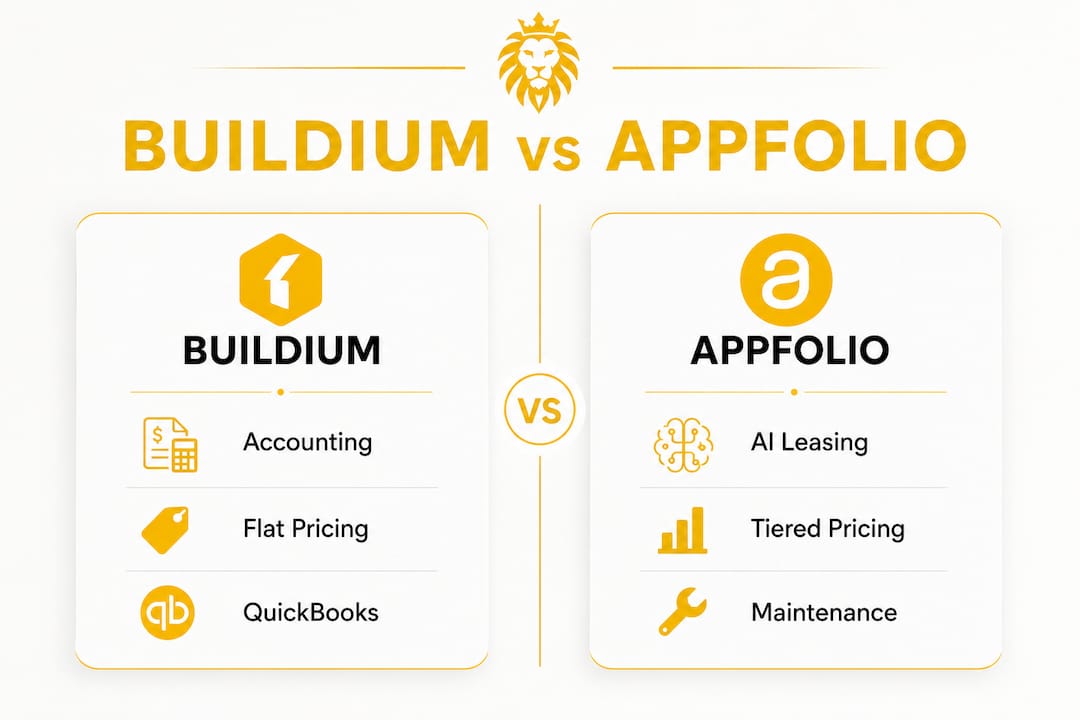
A 100-unit portfolio on Buildium Essential has a monthly cost based on flat-rate pricing. The same portfolio on AppFolio Plus incurs a higher monthly fee depending on transaction volume. AppFolio includes tenant screening in its higher-tier plans; Buildium charges separately for applicant screening.
Hidden fees affect total cost on both sides. Buildium's Essential plan charges $2.50 per electronic lease, $0.50 per outgoing EFT, and 2.99% per credit card transaction. AppFolio bundles more of these costs into its per-unit fee at higher tiers, but the minimum monthly spend makes it a non-starter for portfolios under 150 units.
Pro Tip: Before signing with either platform, calculate your monthly screening volume and lease count. For managers processing 10 or more applicant screenings per month, AppFolio's bundled screening in Plus can offset a meaningful portion of the per-unit premium.
How do Buildium and AppFolio features compare?
Accounting and financial reporting
Buildium's accounting is its clearest competitive advantage. The QuickBooks native integration supports 1099 e-filing, vendor payments, automated bank reconciliation, and detailed owner statements. Property managers with accounting backgrounds consistently rate it best-in-class for property management software. AppFolio's Smart Bill Entry scans PDF invoices and automates bill entry, and its reporting tools are more customizable at scale, but it does not offer QuickBooks integration.
Leasing and tenant communication
AppFolio holds a clear lead. Lisa, its AI leasing assistant, handles prospect inquiries around the clock, schedules showings, pre-qualifies applicants, and automates renewal offers without human intervention. Buildium's leasing workflow is manual: property managers respond to inquiries directly, then route applications through the online portal. For portfolios under 50 units where personal contact matters, that manual approach is workable. Above that threshold, the gap becomes a real capacity constraint.

Maintenance management
Both platforms handle core maintenance workflows including work order management and vendor assignments. AppFolio offers additional automation features that can assist larger teams in managing maintenance volume.
Mobile experience and ease of use
AppFolio's mobile app has higher reported user ratings compared to Buildium's mobile app. AppFolio supports full accounting access, inspections, and work orders from the field. Buildium's mobile app covers the basics but is more limited for on-site operations. On setup, the positions reverse: Buildium generally offers faster onboarding for small operators, while AppFolio may require a longer onboarding period, sometimes involving a paid service.
Unique benefits by platform:
- Buildium: HOA management, QuickBooks sync, no unit minimums, free trial, faster onboarding, lower total cost under 150 units
- AppFolio: AI leasing (Lisa), Realm-X automation, 30+ ILS syndication, multi-entity accounting, superior mobile UX, commercial and student housing support
How to choose between Buildium and AppFolio
Portfolio size is the primary decision variable. The financial break-even sits at roughly 150–200 units, where AppFolio's per-unit pricing normalizes relative to Buildium's flat-rate tiers.
- Choose Buildium if you manage 50–500 units, run HOA or residential portfolios, depend on QuickBooks for accounting, want to onboard quickly, or are not yet at the scale where AppFolio's minimums make financial sense.
- Choose AppFolio if you manage 200 or more units, run high-volume leasing operations where AI automation reduces staffing cost, need enterprise reporting across multiple entities, or manage commercial and mixed-use portfolios.
- Consider onboarding time as a real operational cost. A mid-season platform switch to AppFolio can take 4–8 weeks. Buildium's shorter ramp is a concrete advantage when timing is constrained.
- Account for hidden fees on both sides before committing. Buildium's transaction and e-signature fees add up for active portfolios; AppFolio's per-unit minimums penalize portfolios that haven't yet hit the 150-unit threshold.
- Evaluate automation headroom. If your growth plan targets 300 or more units within 18 months, AppFolio's architecture is worth the higher entry cost. If you're stable at under 150 units, Buildium's accounting depth and pricing structure deliver better value.
For real estate investors tracking cost segregation and depreciation across their portfolios, Buildium's accounting integration with QuickBooks provides a more direct path to the financial reporting those strategies require.
The case for "automation headroom" as the real deciding factor
Most property managers evaluate Buildium and AppFolio by comparing feature checklists. The more useful frame is automation headroom: how much of your leasing, maintenance, and communication workflow can the platform handle without staff intervention as your portfolio grows?
Buildium is an accounting-first platform with solid operational tools, supported by specialized Real Estate SEO Services designed to enhance visibility for property management businesses. It handles the full property management cycle cleanly, and its QuickBooks integration makes it the default choice for managers whose financial reporting requirements are complex. What it does not do is reduce leasing labor at scale. Every prospect inquiry, showing request, and renewal negotiation still requires a person.
AppFolio's Lisa assistant changes that calculus for high-volume operators. The AI handles initial inquiry responses, showing scheduling, application follow-up, and pre-qualification continuously. For a management company processing dozens of lease-ups per month, that automation reduces the headcount required to sustain leasing velocity. The $298/month minimum is not a barrier at that scale; it's a reasonable cost of the infrastructure.
The mistake smaller operators make is choosing AppFolio because it looks more capable, then paying the minimum fee while using only a fraction of the platform's features. Buildium's pricing structure exists precisely for that segment, and its ease of setup means a two-person office can be fully operational without a dedicated IT resource or a paid onboarding engagement.
Financing the portfolio behind your property management platform
Property management software optimizes operations, but it doesn't fund acquisitions. If you're managing a growing portfolio and need capital to add units, Jaken Finance Group offers hard money and fix-and-flip loans structured around asset value rather than credit score, with closings in as few as five days.
Jaken Finance Group provides bridge loans, DSCR rental financing, new construction loans, and gap funding for real estate investors across the United States. The underwriting focuses on the property's value and deal structure, not FICO minimums, making it a practical option for investors scaling portfolios where traditional lenders move too slowly. If your next acquisition needs fast, flexible capital, Jaken Finance Group's asset-based lending is worth a direct conversation.
Key Takeaways
Buildium is the stronger fit for portfolios under 150 units that prioritize accounting depth and predictable pricing; AppFolio earns its premium above 200 units where AI leasing automation and enterprise reporting deliver measurable operational returns.
| Point | Details |
|---|---|
| Cost crossover at 150–200 units | Below that threshold, Buildium's flat-rate pricing delivers better value; above it, AppFolio's per-unit model normalizes. |
| Accounting depth favors Buildium | QuickBooks native integration, 1099 e-filing, and bank reconciliation make Buildium the default for accounting-focused managers. |
| AI leasing favors AppFolio | Lisa handles prospect inquiries, showing scheduling, and pre-qualification 24/7, reducing leasing staff requirements at scale. |
| Onboarding speed matters | Buildium onboards in 1–2 weeks; AppFolio typically requires 4–8 weeks and often a paid onboarding engagement. |
| Jaken Finance Group for capital | For investors growing their portfolio, Jaken Finance Group provides asset-based hard money loans with closings in as few as five days. |