A bridge-to-perm loan is short-term, asset-based financing that funds acquisition, renovation, or lease-up while a property stabilizes, then gets replaced by permanent debt through refinance or paid off at sale. It fits investors who can hit occupancy and net operating income targets within 12 to 24 months. The main risk isn't the loan itself. It's failing to stabilize the asset on schedule, which forces expensive extensions or a rushed sale into a soft market.
TL;DR:
- Fully leverage the timeline by starting permanent refinance discussions at least six months before the bridge loan's maturity to avoid costly last-minute rushes.
- Ensure a properly sized carry reserve, covering interest, taxes, insurance, and potential slow rent increases, by stress testing for occupancy delays and rate hikes.
- Confirm that the property’s actual performance, measured by trailing income and occupancy, meets the lender’s DSCR and occupancy thresholds for a successful refinance.
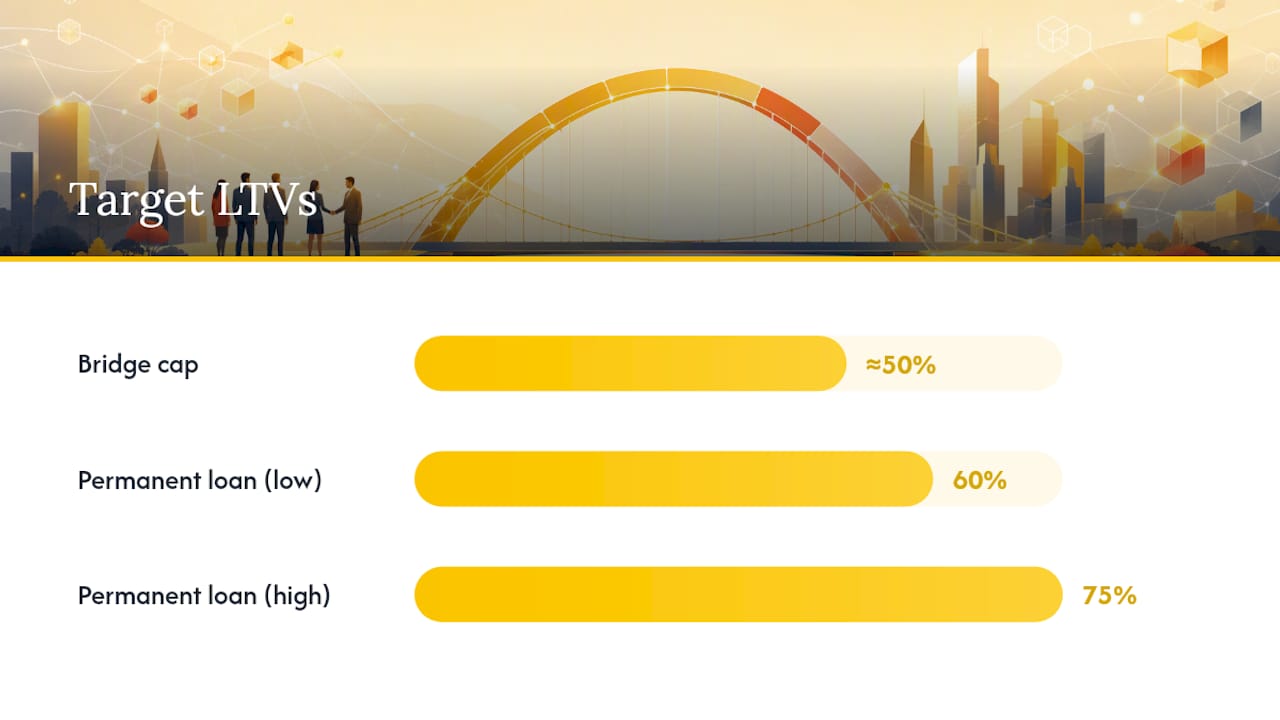
- Size the initial bridge loan around the exit value and maintain conservative leverage, typically around 50% LTV, to allow for a smooth takeout without requiring extra equity infusion.
- Prepare comprehensive documentation, including rent rolls, signed leases, invoices, permits, and updated appraisals, early in the process to expedite approval from permanent lenders.
Table of Contents
- What Bridge-to-Perm Financing Looks Like for Investors
- How the Bridge-to-Perm Timeline Actually Plays Out
- How Permanent Lenders Underwrite Differently
- Sizing the Bridge and Funding a Carry Reserve
- Common Risks and How to Handle Them
- Documentation Checklist to Start the Permanent Refinance
- A Disciplined Approach to Bridge-to-Perm Execution
- Why Jaken Finance Group Fits the Bridge-to-Perm Playbook
- Sources
What Bridge-to-Perm Financing Looks Like for Investors
A bridge-to-perm loan differs from a construction loan in one key way: it doesn't fund the build. It carries the asset through lease-up and stabilization after construction wraps, sized against near-stabilized or as-complete value rather than raw land or hard costs. That distinction matters when you're comparing quotes, because a lender pricing construction risk and a lender pricing stabilization risk are underwriting two different problems.
This is also not the consumer bridge loan your neighbor used to buy a new house before selling the old one. This is investor capital, tied to the property's performance, not a borrower's paycheck.
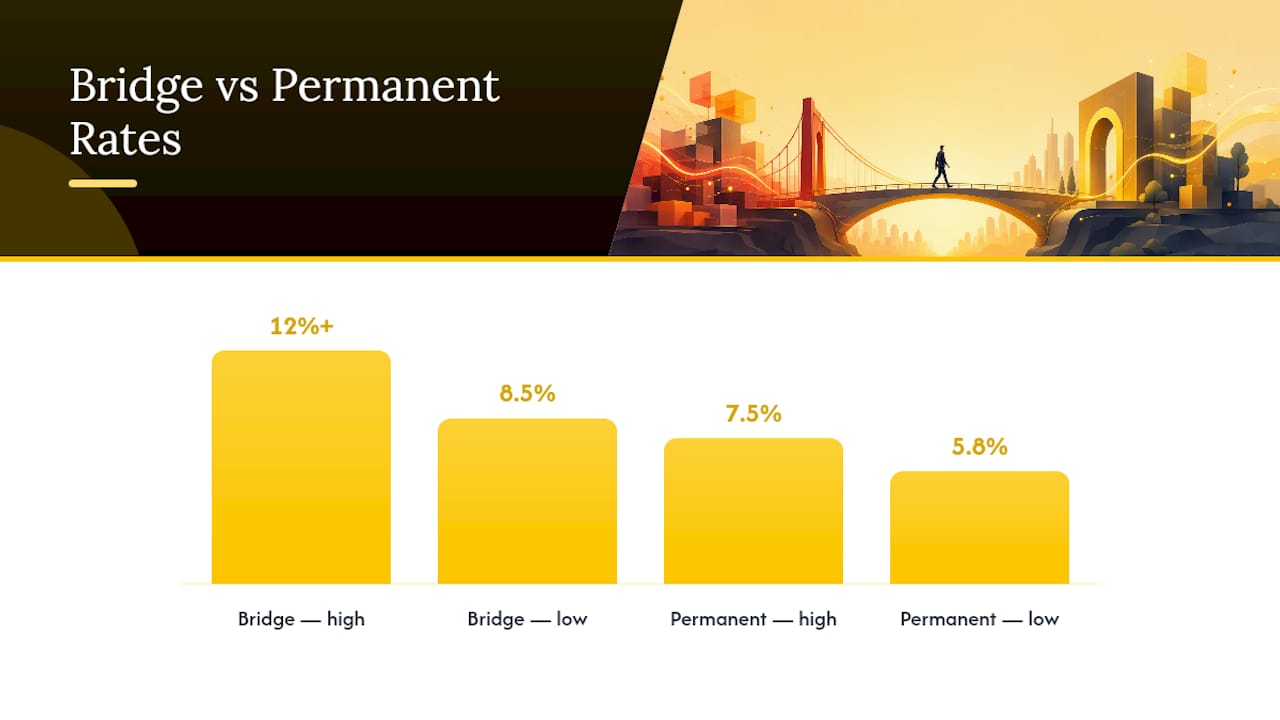
Terms typically run 12 to 24 months, with floating rates that sit well above what permanent debt will eventually cost. Bridge pricing commonly falls in the 8.5% to 12%+ range, while permanent fixed rates for stabilized assets often land between 5.8% and 7.5% depending on the market, according to Requity Group. That spread is the entire incentive structure of the product:
- Buy and renovate — acquisition plus rehab capital ahead of a refinance or resale.
- Lease-up and stabilize — carrying a newly renovated or newly built asset until occupancy and rent rolls support permanent underwriting.
- Construction-complete conversion — moving a finished project from a construction lender's book into a stabilization-focused bridge before perm takeout.
How the Bridge-to-Perm Timeline Actually Plays Out
The clock starts the day the bridge loan closes, and the biggest mistake investors make is treating the maturity date as a distant deadline instead of a countdown. Here's the sequence that keeps a deal on track:
- Close the bridge loan and immediately confirm, in writing, whether your lender expects a takeout or simply expires. Not every bridge product converts cleanly. Some are standalone short-term loans with no documented refinance path, according to Finhelp, so read the exit language before you assume anything.
- Execute renovation or lease-up on the timeline underwritten at closing, tracking trailing income month over month rather than waiting until the end to tally results.
- Hit interim stabilization checkpoints your lender expects, often tied to draw schedules or occupancy milestones at the 6 and 12 month marks.
- Start permanent refinance conversations at least 6 months before maturity. Permanent lenders typically need 45 to 90 days to close and want to see 3 to 6 months of trailing financials showing improved performance, not a snapshot.
- Choose your exit: refinance into permanent debt if the asset is stabilized and rates cooperate, sell if the market favors disposition, or recapitalize with new equity if neither path pencils cleanly.
Waiting until month 10 of a 12-month bridge to call a permanent lender is the single most avoidable error in this entire process.
How Permanent Lenders Underwrite Differently
Bridge lenders price speed and after-repair value. Permanent lenders price stability, and the gap between those two mindsets is where refinances fall apart. A bridge lender looks at what the property will be worth once the work is done. A permanent lender looks at what the property is actually producing, documented over time, with no room for projections.
Permanent underwriting typically centers on:
- Trailing net operating income, usually 3 to 6 months of actual, verifiable performance rather than a pro forma.
- Occupancy thresholds, often 85% or higher for multifamily and similar income-producing assets.
- Tenant lease quality, including lease term, rent escalations, and tenant credit where commercial space is involved.
- Completed capital expenditures, backed by paid invoices, permits, and inspection sign-offs.
Permanent lenders commonly require DSCR in the 1.20 to 1.35x range, according to PeerSense, a threshold that directly caps how much cash-out is available even on a fully stabilized property. Bridge underwriting focused on ARV can badly mismatch this standard. A property that looked great on an after-repair valuation six months ago can still fail a DSCR test if leases came in below projection or expenses ran higher than modeled. The fix is underwriting the perm exit on day one, not backfilling it after the bridge is already funded.
Sizing the Bridge and Funding a Carry Reserve
Size the bridge loan around the exit, not the acquisition. A common discipline among experienced sponsors is capping bridge leverage conservatively, often in the neighborhood of 50% loan-to-value, specifically to leave room for a permanent loan that typically runs 60% to 75% LTV without requiring a forced equity injection at conversion, an approach PeerSense frames as underwriting the takeout first.
The carry reserve is where most novice investors underfund. A properly sized reserve covers:
- Interest payments during renovation or lease-up.
- Property taxes and insurance premiums that don't pause for construction.
- Operating shortfall if rents ramp slower than projected.
Sponsors commonly fund reserves covering 12 to 24 months of carry plus a contingency buffer, protecting against both lease-up delays and floating-rate movement on the bridge loan itself.
Pro Tip: Run two stress tests before you close: one assuming occupancy lags your projection by 90 days, and one assuming your floating bridge rate rises by 150 basis points. If the reserve survives both, you've sized it correctly.
Common Risks and How to Handle Them
Bridge-to-perm loans fail for a small, predictable set of reasons. Slow lease-up tops the list, followed by rehab budgets that overrun their contingency, appraisal values that come in below the number the exit was underwritten against, and interest rate moves that widen the gap between bridge carry and permanent debt service.
None of these are fatal on their own if you have a toolkit ready:
- Extension: most bridge lenders will extend for a fee, often a fraction of a point, if you can show a credible path to stabilization.
- Equity top-up: bringing in additional capital to reduce leverage and satisfy a permanent lender's LTV requirement.
- Recapitalization: replacing part of the capital stack with new equity or mezzanine debt rather than a straight refinance.
- Sale: sometimes the cleanest exit, particularly if permanent debt pricing has moved against you.
Negotiate extension terms before you need them. Lenders are far more flexible discussing a potential extension at month 8 than at month 11, when leverage shifts entirely to their side of the table.
Documentation Checklist to Start the Permanent Refinance
Getting a permanent lender to say yes quickly comes down to having the paperwork ready before they ask for it. Build this checklist in order:
- Trailing rent rolls and NOI statements, ideally 3 to 6 consecutive months showing stabilized or improving performance.
- Signed leases, not letters of intent, for every unit or suite counted toward occupancy.
- Contractor invoices and permits documenting completed capital expenditures, matched against the original scope of work.
- An updated appraisal, ordered early since appraisal turnaround alone can take several weeks during busy cycles.
- Inspection and, where applicable, environmental reports, timed to align with the permanent lender's closing calendar rather than ordered as an afterthought.
Loop in your permanent lender or broker, your property manager, and your CPA at the 6 month mark, not the 2 month mark. Property managers hold the operational records permanent underwriters actually want to see, and a CPA can clean up trailing financials before a lender's underwriter finds the rough edges first. For a deeper look at what documentation trips up borrowers most often, this bridge loan guide walks through common pitfalls in more detail.
A Disciplined Approach to Bridge-to-Perm Execution
Most investors treat the permanent refinance as a problem to solve later. That's backwards. The exit needs to be underwritten before the bridge closes, not six months into a lease-up that's running behind schedule.
Three rules hold up across most deals: size the bridge against the permanent LTV you'll actually qualify for, not the one that lets you close fastest. Fund the carry reserve for the slow scenario, not the average one. And start perm conversations at month 6 of a 12-month loan, not month 10, because permanent lenders move on their own calendar, not yours.
The investors who get burned aren't the ones who misjudged renovation costs. They're the ones who assumed the refinance would take care of itself.
— Jason Taken
Why Jaken Finance Group Fits the Bridge-to-Perm Playbook
The carry-reserve math and exit-timing pressure described above are exactly what asset-based lending is built to solve. Jaken Finance Group underwrites against property value and projected stabilization, not credit score, which means the loan gets structured around your actual exit rather than a rigid income formula.
Certain lenders typically fund fix-and-flip, ground-up construction, and value-add stabilization deals for investors who need capital quickly, with asset-based underwriting rather than minimum credit score requirements. If you're carrying a project toward lease-up and want a lender that understands the permanent takeout matters as much as the initial close, start with the asset-based loan overview to see how the underwriting works, then submit your deal details to get a same-week response.
Sources
For deeper detail on refinance timing, review Avana Capital's bridge-to-permanent breakdown and Requity Group's exit strategy guide. For DSCR and occupancy benchmarks used by permanent lenders, see PeerSense's financing strategy overview. For the construction-versus-stabilization distinction, Atlas Invest's explainer covers it directly. Investors weighing their own deal structure can also review Jaken Finance Group's bridge loan guidance for practical next steps.
- Bridge-to-Permanent Refinance: Converting Bridge Loans into Long-Term CRE Debt | Avana Capital
- What Is a Bridge Loan Exit Strategy? | Requity Group
- Bridge-to-Permanent Financing Strategy for Commercial Real Estate | PeerSense