
No single carrier wins every scenario. For single-family buy-and-hold rentals, Travelers and State Farm lead on financial strength and agent support. Multi-unit portfolio investors should prioritize Travelers and Nationwide for rental-income protections. Short-term rental operators fit best with Allstate or Progressive for endorsement flexibility. High-value or specialty properties call for Chubb or Liberty Mutual. Military-affiliated investors should start with USAA.
Scenario-to-carrier shortlist:
- Single-family buy-and-hold: Travelers (strong financials, rental income coverage) or State Farm (deep agent network)
- Multi-unit portfolios: Travelers or Nationwide (business-interruption and DP-3 forms)
- Short-term rentals: Allstate (STR endorsements in select markets) or Progressive (digital quoting, competitive pricing)
- High-value/specialty properties: Chubb (bespoke underwriting, high liability limits) or Liberty Mutual (broad endorsement menu)
- Military-affiliated investors: USAA (top-rated claims service, eligibility-restricted)
- New or small-scale landlords: Lemonade (fast digital quotes) or Progressive (direct online binding)
- Agent-negotiated, complex risks: Farmers (custom endorsements, local agent capacity)
Before binding any policy, run three trust checks: verify AM Best or S&P financial strength (A or better), pull the NAIC complaint index for the carrier in your state, and confirm the policy includes proper mortgagee clause wording as required by your lender.
Table of Contents
- Best landlord insurance companies compared at a glance
- How landlord insurance differs from homeowners insurance
- What a landlord policy covers and which endorsements investors need
- Which carrier fits your investor scenario?
- Jaken Finance Group closes deals when insurance timelines are tight
- Key Takeaways
Best landlord insurance companies compared at a glance
Choosing the right carrier requires evaluating financial strength, complaint records, and coverage types together — no single dimension tells the full story.
| Carrier | Best For | Quoting Channel | Core Coverages & Key Endorsements | AM Best Rating | NAIC / Service Signal |
|---|---|---|---|---|---|
| State Farm | Multi-state, high-value portfolios | Agent-served | Dwelling, liability, loss of rental income, ordinance & law | A++ | Below-average complaints |
| Allstate | STR investors, bundling | Agent + online | Dwelling, liability, STR endorsements, multi-policy discount | A+ | Average |
| Nationwide | Single-family, small multi-unit | Agent + online | DP-3 forms, liability, rental income, water backup | A+ | Average |
| Farmers | Complex/custom risk, agent markets | Agent-served | Custom endorsements, dwelling, liability, vacancy riders | A | Average |
| Liberty Mutual | High-value, specialty add-ons | Agent + online | Dwelling, liability, inflation protection, broad endorsement menu | A | Above-average complaints in some states |
| Travelers | Multi-unit, rental income focus | Agent + online | DP-3, business interruption, premises liability, outbuildings | A++ | Below-average complaints |
| USAA | Military-affiliated investors | Direct/online | Dwelling, liability, loss of rental income, bundling discounts | A++ | Excellent — eligibility restricted |
| Progressive | Digital-first, single-family | Direct/online | Dwelling, liability, competitive pricing, digital tools | A+ | Average |
| Lemonade | New landlords, small-scale | — | Dwelling, liability, fast digital binding | A- (Demotech) | Limited track record |
| Chubb | High-value, bespoke coverage | Agent-served | High limits, specialty underwriting, custom endorsements | A++ | Below-average complaints |
Deal-killers to check before binding: vacancy exclusions that trigger after 30 days, missing mortgagee clause, and rental income coverage that does not meet lender minimums.
How landlord insurance differs from homeowners insurance
A homeowners policy is written for owner-occupied properties. When a tenant moves in, that policy form can leave critical gaps: no loss of rental income, limited liability for tenant injuries, and potential claim denial if the insurer determines the property was not owner-occupied at the time of loss. Using the wrong policy form is one of the most common and costly mistakes investors make.
Key differences that affect investors directly:
- Loss of rental income: Landlord policies include fair rental value or business-interruption coverage; standard HO-3 forms do not.
- Policy form (DP-1 vs. DP-3): DP-1 covers named perils only; DP-3 is open-peril and preferred by most lenders for financed deals.
- Vacancy rules: Most landlord policies restrict coverage after 30–60 days of vacancy without a specific endorsement.
- Permitted occupancy: Short-term rentals require explicit endorsements; standard landlord forms often exclude them.
- Liability scope: Landlord liability covers tenant and visitor claims on the premises; homeowners liability does not extend to tenant-occupied exposures.
Pre-closing checklist for investor borrowers:
- Confirm the policy form is DP-3 (or equivalent open-peril commercial form).
- Verify the mortgagee clause names the lender correctly with proper notification language.
- Check the cancellation notice period meets lender requirements (typically 10–30 days).
- Confirm loss of rental income / business-interruption coverage meets lender minimums.
- Add a vacancy endorsement if the property will be vacant during rehab or between tenants.
Pro Tip: Treat vacancy timing as a deal term. Confirm with your carrier exactly when the vacancy clock starts and whether your rehab schedule falls within the covered window before you close.
What a landlord policy covers and which endorsements investors need
Core coverages in a standard landlord policy:
- Dwelling/property damage: Covers the structure against covered perils (fire, wind, hail, vandalism).
- Other structures: Extends coverage to detached garages, fences, and outbuildings on the property.
- Liability: Pays for bodily injury or property damage claims brought by tenants or visitors.
- Medical payments: Covers minor medical costs for injuries on the premises, regardless of fault.
- Loss of rental income: Reimburses lost rent when a covered loss makes the unit uninhabitable.
High-value endorsements for active investors:
- Ordinance & law (covers code-upgrade costs after a covered loss)
- Water backup and sump overflow
- Vacancy endorsement (extends coverage during rehab or tenant turnover)
- Building-code upgrade coverage
- Short-term rental / host liability rider
- Earthquake or flood riders (where available; flood requires a separate NFIP or private policy)
Vacancy window alert: Many landlord policies stop covering a property after 30–60 days of vacancy unless a vacancy endorsement is in place. For BRRRR investors or anyone running a fix-and-flip rehab schedule, this timing gap is a frequent source of claim denial.
Premium drivers include location and weather exposure, construction type and property age, occupancy type, claims history, and security features. Underwriting factors like monitored alarm systems and updated roofing can reduce premiums materially. Multi-policy bundling with auto or umbrella coverage is the most accessible discount lever across most carriers. For investors managing insurance costs against cap-rate sensitivity, these premium drivers directly affect net operating income projections.
Which carrier fits your investor scenario?
No universal winner exists across all investor types. The right carrier depends on property type, portfolio complexity, and lender requirements.

State Farm suits investors who need local agent advocacy for complex, multi-state portfolios. Its A++ AM Best rating and broad agent network make it a reliable choice where direct carrier relationships matter at closing.
Travelers is the strongest fit for multi-unit landlords who need documented rental-income protections. Its A++ rating and below-average NAIC complaint index support lender confidence on financed deals.
Chubb handles high-value or unusual properties that standard carriers decline or underinsure. Bespoke underwriting and high liability limits make it the default for luxury or mixed-use assets.
Lemonade and Progressive serve new landlords or single-family investors who need fast digital quotes without agent involvement. Lemonade's online binding speed suits small-scale operators; Progressive's direct-quote tools work well for straightforward occupancies.
Farmers is the agent-negotiated option for investors facing specific local risks, unusual construction, or endorsement requirements that standard policy forms cannot accommodate.
Quick-quote checklist for fast closings:
- Have the property address, year built, construction type, and square footage ready.
- Know your desired coverage limits and any lender-specified minimums.
- Confirm occupancy status (vacant, tenant-occupied, STR) before the quote call.
- Request the mortgagee clause addition at the time of quoting, not after binding.
- Ask for a binder or evidence of insurance within 24 hours if your closing timeline is tight.
Jaken Finance Group closes deals when insurance timelines are tight
Real estate investors using hard money and fix-and-flip loans from Jaken Finance Group do not wait weeks for underwriting decisions. Jaken Finance Group structures asset-based loans around property value, not credit scores, and closes in as few as five days. That speed creates a specific insurance coordination challenge: lenders need mortgagee clauses, cancellation notices, and rental income coverage confirmed before funding.
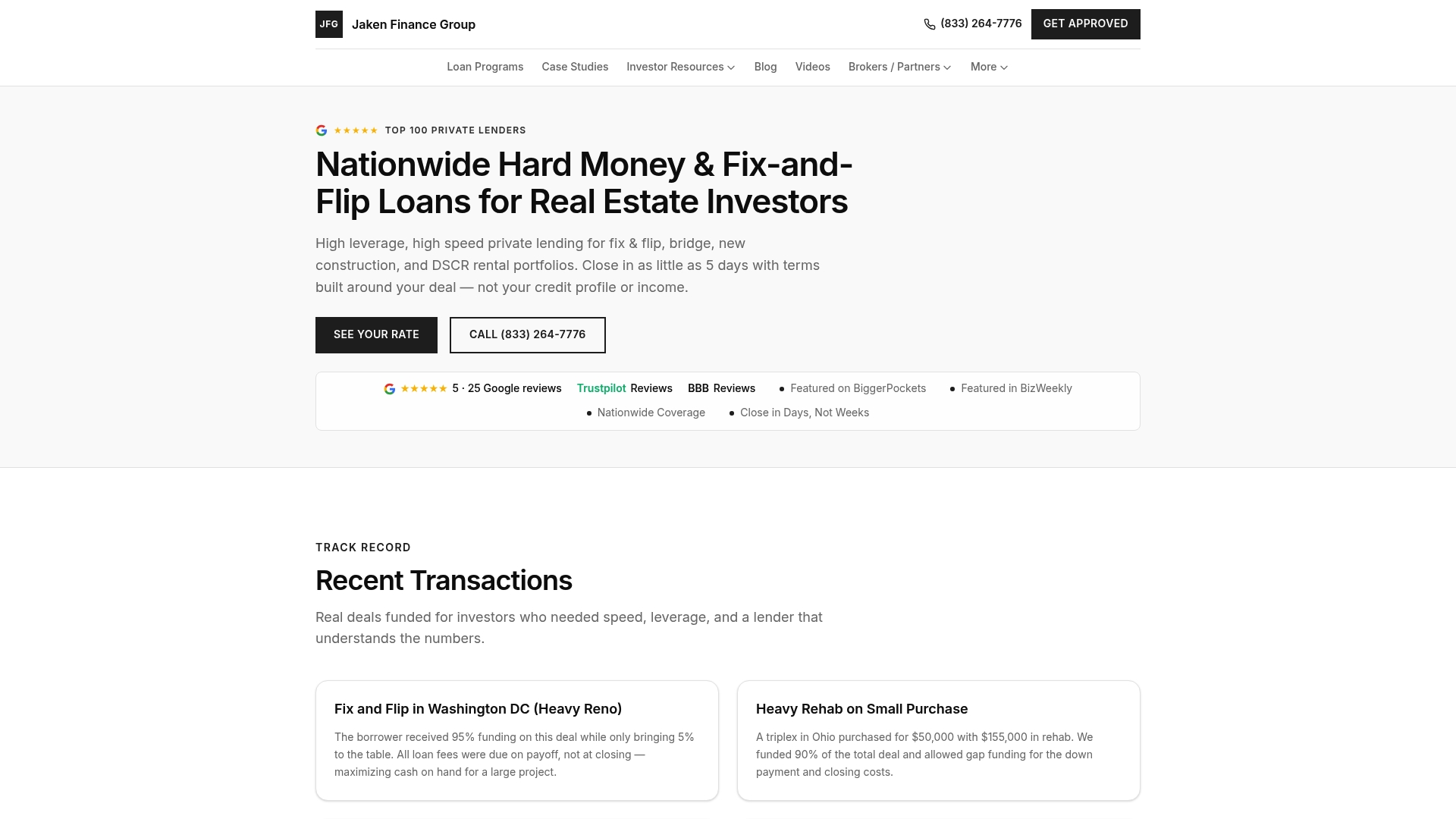
Jaken Finance Group's loan process accounts for these requirements directly. Borrowers receive clear documentation of mortgagee wording requirements early in the process, reducing last-minute insurance delays at closing. Services available to investor borrowers include hard money, DSCR rental, bridge, new construction, and down payment funding for short-term loans. For investors managing California's shifting insurance market or other high-risk regions, Jaken Finance Group's flexible underwriting accommodates properties where conventional lenders stall. Contact Jaken Finance Group to start a loan application and get your insurance requirements confirmed before your next closing.
Key Takeaways
The best landlord insurance companies are matched to investor scenario, not selected by a single universal ranking.
| Point | Details |
|---|---|
| Scenario-based selection | Match the carrier to your property type: Travelers for multi-unit, Chubb for high-value, Lemonade for digital-first small landlords. |
| Vacancy window risk | Policies typically lapse after 30–60 days vacancy; add a vacancy endorsement before any rehab or tenant-turnover period. |
| Lender-required mechanics | Confirm DP-3 form, mortgagee clause, cancellation notice period, and rental-income coverage before binding for a financed deal. |
| Trust signals to verify | Check AM Best rating (A or better), NAIC complaint index for your state, and JD Power claims satisfaction where available. |
| Jaken Finance Group | Provides asset-based hard money and DSCR loans with clear mortgagee requirements, closing in as few as five days nationwide. |
This article is general information for real estate investors and does not constitute insurance or legal advice. Confirm current policy terms, coverage requirements, and carrier availability with a licensed insurance professional and your lender before binding coverage.