
An ARV appraisal is a bank-grade valuation of a property as if all planned renovations are complete. The appraiser issues the opinion under a USPAP-required hypothetical condition, labeled "subject to completion," and the resulting number drives loan sizing, offer math, and draw schedules. To estimate ARV quickly, pull a few closed comps of renovated properties within a nearby area, adjust each for square footage, condition, and finish level, then take a weighted average of the adjusted prices. Convert that figure to a Maximum Allowable Offer using the 70% rule: MAO = (ARV × 70%) − estimated renovation costs.
Two program standards every investor should know before ordering an ARV appraisal:
- USPAP governs every licensed appraiser in the United States and mandates conspicuous disclosure of the hypothetical condition that makes an ARV opinion valid.
- FHA 203(k) and Fannie Mae HomeStyle are the two primary government-backed renovation loan programs that use ARV to cap borrowing limits and structure draw releases.
Key Takeaways
A defensible ARV appraisal requires a USPAP-compliant hypothetical condition disclosure, 3–5 closely matched renovated comps with documented adjustments, and a line-item scope of work that specifies materials and finishes precisely enough for the appraiser to match comps to the planned finished condition.
| Point | Details |
|---|---|
| ARV is a hypothetical condition appraisal | The opinion is issued "subject to completion" under USPAP and becomes final only after a verified completion inspection. |
| Comp quality determines accuracy | With 4+ closely matched comps, investor ARV estimates typically land within 3–5% of the formal appraisal. |
| SOW specificity drives the ARV number | Line-item material specifications allow the appraiser to match comps to the planned finish level and reduce conservative adjustments. |
| MAO = (ARV × 70%) − renovation costs | Budget for an appraisal shortfall of 5–10% below your estimate when structuring the offer price. |
| Jaken Finance Group sizes loans on ARV | Asset-based underwriting focuses on the property's completed value; a complete SOW and contractor bids are the core approval documents. |
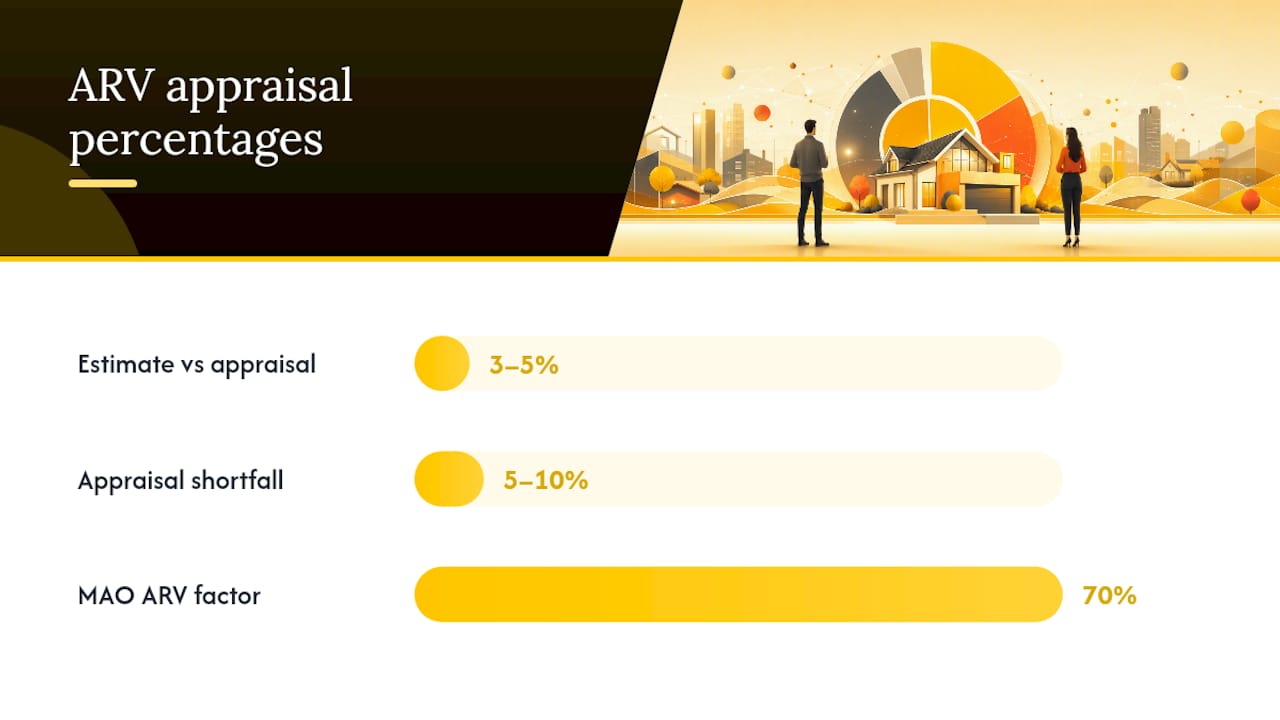
Table of Contents
- What does ARV actually mean in appraisal terms?
- What does the ARV appraisal process look like step by step?
- How do appraisers actually calculate ARV?
- How can investors estimate ARV on their own?
- What should your scope of work include for a defensible ARV?
- How do lenders use ARV to structure renovation loans?
- What pitfalls make ARV unreliable and how do you avoid them?
- A numeric worked example: building ARV from comps and computing MAO
- What data sources and tools help you build a defensible ARV?
- What does an ARV appraisal cost and how long does it take?
- What lenders actually look for in an ARV report
- Jaken Finance Group funds rehab projects based on ARV
- Sources
What does ARV actually mean in appraisal terms?
After repair value, or ARV, is the appraiser's estimate of a property's market value in its fully renovated, as-completed condition. It is not the current value. It is not a projection of appreciation. It is a hypothetical condition appraisal that assumes all planned work has been finished to the specifications described in the scope of work, even though that work has not yet occurred.
Under USPAP, an appraiser may only use a hypothetical condition when it is reasonable, when it does not misrepresent the property, and when it is conspicuously disclosed in the report. That disclosure is what separates a defensible ARV from a speculative estimate. Without it, the appraisal cannot be used by a federally regulated lender.
The contrast with an as-is appraisal is significant for investors. An as-is appraisal reflects current condition, current deferred maintenance, and current market demand for a distressed or unrenovated asset. ARV reflects a different property: one with updated kitchens, new mechanical systems, or added square footage. Lenders use that gap between as-is value and ARV to determine how much renovation financing they can extend.
Who relies on ARV appraisals:
- Fix-and-flip investors calculating a maximum offer price
- Owner-rehabbers applying for FHA 203(k) or Fannie Mae HomeStyle renovation loans
- Private and hard money lenders sizing loan amounts against completed value
- Contractors and developers verifying that a renovation budget is justified by market return
The HUD appraisal handbook requires appraisers working on FHA-related assignments to define the type of value, indicate the effective date, follow USPAP, and document any extraordinary assumptions or limiting conditions — all of which apply directly to an ARV assignment.
What does the ARV appraisal process look like step by step?
The ARV appraisal process follows the same formal structure as any licensed appraisal, with two additional layers: pre-inspection review of renovation documentation and a post-completion verification. Here is how it unfolds from order to final report.
-
Assignment conditions and problem definition. The appraiser establishes the purpose (market value), the effective date (typically the date of inspection or the order date), the intended use (renovation loan underwriting or investor decision-making), and the hypothetical condition (the property is assumed complete per the provided scope of work). This step determines whether the appraisal will be issued "subject to completion" or under another extraordinary assumption.
-
Pre-inspection document review. Before visiting the property, the appraiser reviews the scope of work, contractor bids, architectural drawings or floor plans, permit applications, and any photos of current condition. Vague descriptions at this stage, such as "update kitchen" without specifying cabinet grade, countertop material, or appliance tier, force the appraiser to make conservative assumptions that typically reduce the ARV.
-
On-site inspection. The appraiser measures the property, photographs all rooms and exterior elevations, notes current condition, identifies deferred maintenance, and confirms that the existing structure matches the plans provided. For a gut renovation, the appraiser documents the baseline so the hypothetical condition is clearly defined.
-
Comparable sales research and market analysis. The appraiser pulls closed sales of renovated properties within a defined search radius, typically within a nearby urban market area and wider in rural areas. The sales comparison approach is the primary method for single-family residential ARV appraisals when sufficient comps exist. The appraiser also reviews active listings and pending sales to assess market direction.
-
Adjustments and reconciliation. Each comparable sale is adjusted for differences in square footage, bedroom and bathroom count, lot size, garage, condition, finish level, and location. The appraiser reconciles the adjusted values into a single ARV, weighting comps that most closely match the subject's planned finished condition.
-
Report delivery, labeled "subject to completion." The final report states the ARV with the hypothetical condition prominently disclosed. The opinion of value is contingent on the renovations being completed as described. Lenders will not fund against this number until a completion inspection confirms the work is done.
-
Completion inspection (Form 1004D). After renovation, the lender orders a re-inspection. The appraiser returns, confirms the work matches the SOW, and certifies completion. This triggers final draw releases or loan conversion.
Typical timeline from order to report: 1–3 weeks for the initial ARV appraisal, depending on comp availability, document completeness, and appraiser workload. Completion inspections typically take 3–7 business days once ordered.
Common bottlenecks:
- Incomplete or vague SOW submitted at order
- Appraiser unable to locate sufficient renovated comps in the subject's submarket
- Permit delays that change the scope after the appraisal is issued
- Lender-required appraiser roster restrictions (FHA 203(k) requires FHA-approved appraisers)
Pro Tip: Submit the SOW, contractor bids, and floor plans at the time you order the appraisal, not after the inspection. Appraisers who receive complete documentation before the site visit produce more accurate and faster reports.
How do appraisers actually calculate ARV?
The mechanics of ARV calculation center on the sales comparison approach, which the Colorado Division of Real Estate's appraisal guidance identifies as the preferred method when sufficient comparable sales exist. The appraiser selects comps, makes dollar adjustments for differences, and reconciles the results into a single value opinion.
Comp selection criteria:
- Sold within a recent timeframe appropriate for the market, shorter in fast-moving markets
- Located within a nearby urban or suburban market area
- Similar gross living area within a reasonable range of the subject's planned finished size
- Similar bedroom and bathroom count
- Renovated or updated condition that approximates the planned finish level
Adjustment categories appraisers apply:
- Gross living area (GLA): Typically adjusted at a per-square-foot rate derived from paired sales analysis in the local market. A common residential range is $50–$150 per square foot, but the appraiser must derive this from actual market data, not a rule of thumb.
- Bedroom and bathroom count: Adjustments vary by market; a missing full bath in a comparable might carry a $5,000–$15,000 adjustment.
- Lot size: Relevant in markets where lot premium is demonstrable; often $0 in dense urban infill.
- Garage: Typically $5,000–$20,000 per space depending on market.
- Condition and finish level: The most subjective adjustment in an ARV appraisal. A comp with builder-grade finishes compared to a subject with high-end finishes may require a $15,000–$40,000 upward adjustment.
- Functional utility: Layout changes, open floor plans, and added square footage all carry adjustments derived from paired sales.
When cost or income approaches matter:
The cost approach becomes a meaningful cross-check when the renovation budget is large relative to the expected value increase. If the appraiser's cost approach shows that $80,000 in renovation costs would add only $50,000 in market value, that is a red flag the appraiser will note in the report. For multifamily properties of five or more units, the income approach (capitalized net operating income) often carries more weight than sales comparison, and the ARV reflects stabilized rental income at completed condition. For single-family rentals, a DSCR appraisal with a 1007 rent schedule may accompany the ARV report.
Per-square-foot cross-check example:
If three renovated comps in the subject's neighborhood sold at an average of $185 per square foot, and the subject's planned finished area is 1,400 square feet, the per-sq-ft ARV estimate is $259,000. That figure should align reasonably with the adjusted comp average. A significant divergence signals either a comp selection problem or an adjustment error.
Pro Tip: Ask the appraiser which comp they weighted most heavily and why. The answer tells you whether the appraiser understands the local renovation premium or is defaulting to the closest sale regardless of condition.
How can investors estimate ARV on their own?
Investors routinely estimate ARV before ordering a formal appraisal to screen deals and set offer limits. The three-step investor method uses publicly available data and produces estimates that, with strong comps, typically land within 3–5% of the eventual appraisal.
-
Establish the property's current condition and planned finish level. Document what the property is today (square footage, bedroom/bath count, condition) and what it will be after renovation (same metrics, plus finish grade). This defines the "as-completed" subject the comps must match.
-
Pull 3–5 closed comparable sales. Use MLS data through a licensed agent, county recorder records, or a closed-sale aggregator. Target sales within the past 6 months, within a half-mile in urban markets, and within 15% of the planned finished square footage. Renovated or fully updated condition is required; distressed or unrenovated sales are not valid comps for ARV.
-
Adjust each comp and compute a weighted average. For each comp, add or subtract for square footage differences, bedroom/bath count, lot, garage, and condition. Weight comps that most closely match the subject's planned finished condition more heavily. The weighted average of adjusted prices is your ARV estimate.
Weighted average vs. median: A weighted average lets you assign more influence to the closest comps. A simple median is faster but treats all comps equally. For a 3-comp set with one clearly superior match, the weighted average produces a more defensible number.
This investor heuristic is not a regulatory rule, and local markets or lender policies may justify different caps.
Worked example:
- ARV estimate: $300,000
- Estimated renovation costs: $50,000
- MAO = ($300,000 × 70%) − $50,000 = $210,000 − $50,000 = $160,000
Sensitivity check:
Repair cost validation checklist:
- Line-item bids from at least two licensed contractors
- Separate labor and materials costs per trade
- Contingency allowance of 10–15% for unforeseen conditions
- Permit fees included in the budget
- Carrying costs (insurance, taxes, utilities) for the renovation period
That buffer prevents cash shortfalls at closing and keeps the deal viable if the appraiser applies conservative adjustments.
What should your scope of work include for a defensible ARV?
The scope of work is the single document that most directly determines whether an ARV appraisal is credible or conservative. Vague descriptions are a frequent cause of stalled appraisals and conservative valuations. An appraiser who reads "update kitchen" cannot determine whether the subject will match a $180,000 comp with quartz countertops and custom cabinetry or a $140,000 comp with laminate and stock cabinets.
Line-item SOW requirements:
- Kitchen: Cabinet brand and grade (e.g., semi-custom shaker, solid wood), countertop material (quartz, granite, laminate), appliance tier (stainless steel, brand and model if specified), flooring material and square footage, lighting fixtures
- Bathrooms: Vanity type and dimensions, tile material and coverage area, fixture brand and finish (chrome, brushed nickel), shower/tub configuration
- Flooring: Material by room (LVP, hardwood, tile), square footage per area
- Mechanical systems: HVAC brand and tonnage, water heater type and capacity, electrical panel upgrade (amperage)
- Structural and layout changes: Load-bearing wall removals, additions, square footage changes with dimensions
- Exterior: Roofing material and warranty, siding type, window brand and U-factor, landscaping scope
- Permits: List each permit required, the issuing jurisdiction, and expected timeline
Contractor bid format lenders and appraisers expect:
- Itemized by trade (framing, plumbing, electrical, HVAC, finish carpentry, painting)
- Labor and materials broken out separately per line item
- Total project cost, payment schedule, and projected completion date
- Contractor license number and insurance certificate
Supporting documents to include in the appraisal package:
- Architectural drawings or floor plans (dimensioned, showing any layout changes)
- Before photos of all rooms and exterior elevations
- Permit applications or issued permits
- Title report or lot data confirming legal description and square footage
- Survey if lot dimensions are relevant to the renovation scope
Pro Tip: Attach the contractor bid directly to the SOW as a single PDF package when submitting to the appraiser. Appraisers who receive a unified document package produce reports faster and with fewer requests for clarification.
How do lenders use ARV to structure renovation loans?
ARV is the ceiling, not the floor, of renovation loan sizing. Lenders cap the loan amount at a percentage of ARV, and that cap determines how much capital an investor or homeowner can access. Understanding where those caps sit across different programs prevents surprises at underwriting.
Program ARV caps and loan structures:
- FHA 203(k): The loan amount cannot exceed the lesser of the appraised ARV or the applicable FHA loan limit for the area. The FHA 203(k) program requires a HUD-approved 203(k) consultant to review the SOW and contractor bids, and the appraiser must be FHA-approved. Draws are released in stages as work is verified.
- Fannie Mae HomeStyle: The loan amount is capped at the lesser of the ARV or the purchase price plus renovation costs. HomeStyle allows a broader range of improvements than 203(k), including luxury upgrades, and uses a standard Form 1004 appraisal with the "subject to completion" designation.
- Private and hard money programs: LTV caps against ARV vary by lender but commonly range from 65–75% of ARV for fix-and-flip programs. Some lenders also apply a loan-to-cost (LTC) cap. Understanding LTV and ARV caps in hard money lending is critical before structuring a deal.
Draw schedules and completion verification:
Renovation loan funds are not released in a lump sum. Lenders hold back a portion of the renovation budget and release it in draws as work is completed and verified. The verification process typically works as follows:
- Borrower requests a draw after completing a defined phase of work.
- Lender orders a draw inspection (often using Form 1004D or a lender-specific inspection form).
- Inspector confirms the percentage of work completed and the quality of materials installed.
- Lender releases the draw proportional to verified completion.
- Final draw is released only after full completion is confirmed and the appraiser certifies the property matches the SOW.
Borrower checklist to avoid funding delays:
- Submit a complete SOW and contractor bids at loan application, not after approval
- Use licensed, insured contractors with verifiable track records
- Pull all required permits before starting work
- Maintain a draw request log with photos documenting each phase
- Communicate timeline changes to the lender immediately; scope changes after the appraisal is issued may require a revised appraisal
Common lender objections at draw review:
- Work completed does not match the approved SOW (substituted materials or skipped line items)
- Unpermitted work discovered during inspection
- Contractor replaced without lender notification
- Timeline overrun that pushes the project past the loan's interest reserve period
The HUD appraisal handbook requires appraisers to document why a particular approach to value was chosen and how adjustments were derived, which means the appraiser's file must support every number in the report. Lenders reviewing the appraisal for underwriting will check that documentation against the SOW and contractor bids.
What pitfalls make ARV unreliable and how do you avoid them?
ARV errors compound quickly. The most common failure points are identifiable and preventable.
Red flags that reduce ARV credibility:
- Comps that are more than 12 months old in an active market
- Comps located more than one mile away in a dense urban submarket
- Comps with significantly different square footage (more than 20% variance) used without adequate adjustment
- Unrenovated or distressed sales used as comps for a fully renovated subject
- SOW that describes finishes in generic terms without material specifications
- Unpermitted additions or conversions included in the planned square footage
- Renovation budget that does not account for structural issues discovered during inspection
Mitigation steps:
- Pull comps from the same neighborhood, not just the same zip code
- Verify that each comp was actually renovated to a comparable finish level by reviewing MLS photos
- Specify every material in the SOW with brand, grade, and model where possible
- Get permits for all work that requires them; unpermitted work cannot be included in the ARV
- Obtain two contractor bids and use the higher one for conservative budgeting
- Stage a 10–15% contingency allowance for unforeseen structural or mechanical conditions
Market timing and volatility:
ARV appraisals carry an effective date. If the market shifts significantly between the appraisal date and the renovation completion date, the ARV may no longer reflect current market conditions. In a declining market, the appraiser's value opinion from six months ago may exceed what the property would actually sell for today. Lenders may require an updated appraisal or a re-inspection with a market conditions addendum if the renovation timeline extends beyond 6–12 months.
A numeric worked example: building ARV from comps and computing MAO
Subject property facts:
- Current condition: 3 bed / 1 bath, 1,200 sq ft, distressed
- Planned finished condition: 3 bed / 2 bath, 1,400 sq ft (addition), fully renovated
- Renovation budget: $65,000
- Location: urban infill market
Comparable sales grid:
ARV calculation:
- Assign weights: Comps 1 and 2 are closest in size and condition; weight each at 30%. Comps 3 and 4 at 20% each.
- Weighted ARV = ($280,000 × 30%) + ($272,000 × 30%) + ($285,000 × 20%) + ($265,000 × 20%)
- Weighted ARV = $84,000 + $81,600 + $57,000 + $53,000 = $275,600
Per-square-foot cross-check:
Average adjusted price per sq ft across comps: ($280,000 + $272,000 + $285,000 + $265,000) ÷ 4 = $275,500 ÷ 4 = $193.75/sq ft × 1,400 sq ft = $271,250
Use $275,000 as the working ARV (rounded conservatively).
MAO calculation:
Sensitivity scenarios:
What data sources and tools help you build a defensible ARV?
No ARV estimate is stronger than the data behind it. The quality of the comps determines whether the investor's estimate and the formal appraisal converge or diverge.
Primary data sources:
- MLS (Multiple Listing Service): The most reliable source for closed sale data, including interior photos, days on market, and condition notes. Access requires a licensed real estate agent or broker. MLS data reflects actual contract prices and is the same source appraisers use.
- County recorder and assessor records: Publicly available in most jurisdictions. Useful for confirming sale prices, legal descriptions, and square footage. Data is often 30–90 days behind actual closings, which matters in fast-moving markets.
- Closed-sale aggregators: Platforms that aggregate public record data provide broad coverage but may lag MLS data by weeks and sometimes omit seller concessions that affect the net sale price.
Calculator and spreadsheet approach:
Build a simple comp adjustment spreadsheet with columns for sale price, GLA, bedroom/bath count, lot size, garage, condition, and each adjustment category. Document the per-square-foot rate you used for GLA adjustments and the source of that rate (paired sales analysis or appraiser guidance). When you submit the package to the appraiser, include your comp grid. Appraisers who see that an investor has done rigorous pre-work are more likely to engage with the investor's comp selection rather than defaulting to their own search.
When to hire a professional appraiser vs. DIY:
Use a professional ARV appraisal for any transaction involving a renovation loan (FHA 203(k), Fannie Mae HomeStyle, or hard money programs), any deal where the renovation budget exceeds $40,000, or any property type where comps are scarce. For manufactured homes, the comp selection challenges are significant enough that a professional appraisal is almost always necessary. For manufactured home ARV and comp selection, standard residential comps often do not apply.
Caveats by source:
- MLS data requires agent access; investors without an agent relationship should establish one before deal flow begins
- Public records lag actual market activity and may not reflect seller concessions
- Automated valuation models (AVMs) are not substitutes for a licensed appraisal and are not accepted by lenders for renovation loan underwriting
What does an ARV appraisal cost and how long does it take?
ARV appraisals cost more and take longer than standard residential appraisals because the appraiser must review renovation documentation in addition to conducting normal comparable sales research.
Typical fee and timeline ranges:
| Service | Typical Fee | Typical Timeline |
|---|---|---|
| ARV appraisal (single-family) | $50–$150 | 1–3 weeks from order |
| Completion inspection (Form 1004D) | $150–$300 | 3–7 business days from order |
| Expedited ARV appraisal | $5,000–$15,000 | 3–7 business days |
| Rural or complex property ARV | $700–$—+ | 2–4 weeks |
Fee data sourced from LegalClarity's ARV appraisal cost guidance.
Factors that increase cost:
- Complex scope of work requiring review of architectural drawings
- Rural markets where comps require extended search radius
- Expedited turnaround requested by the lender or investor
- Multifamily or mixed-use properties requiring income approach analysis
- Appraiser roster restrictions (FHA-approved appraisers may carry a premium)
Scheduling tips to avoid market drift:
- Order the ARV appraisal as early as possible in the financing process, not after the purchase contract is signed
- Confirm the appraiser's availability before submitting the loan application to avoid timeline mismatches
- If the renovation extends beyond 6 months, discuss with the lender whether an updated appraisal or market conditions addendum will be required before the final draw
- Schedule the completion inspection at least two weeks before the planned draw request to allow for report delivery and lender review
What lenders actually look for in an ARV report
Most ARV appraisals that stall at underwriting fail for the same reasons: the SOW was vague, the comps were weak, or the renovation budget did not align with the finish level described. From a lender's perspective, the appraisal report is only as credible as the documentation package that supported it.
The most common failing is a mismatch between the renovation budget and the finish level claimed in the SOW. An investor who budgets $30,000 for a full kitchen and two bathroom renovations in a market where comparable renovations cost $55,000 will produce an ARV that the appraiser cannot support with matching comps. The appraiser will either reduce the finish level assumption or flag the budget as insufficient, both of which compress the ARV.
Lenders also scrutinize the comparable sales grid for adjustment size. An appraiser who relies heavily on a comp requiring large adjustments is signaling that better comps were not available, which is itself a risk flag.
What speeds approvals: a complete SOW with material specifications, contractor bids broken out by trade, permits pulled or applied for, and a comp grid that the investor prepared in advance. Jaken Finance Group's asset-based underwriting approach focuses on property value and project viability, which means a well-documented ARV package carries more weight than credit score in the initial review.
Jaken Finance Group funds rehab projects based on ARV
Investors who have a defensible ARV, a line-item SOW, and contractor bids in hand can move from application to funding faster than they typically expect. Jaken Finance Group structures fix-and-flip and rehab loans around the property's completed value, not the borrower's credit profile, which means the ARV package is the core underwriting document.
Minimum preflight documents Jaken requests:
- Scope of work with line-item materials and finishes
- Contractor bids broken out by trade (labor and materials separate)
- Floor plans or architectural drawings if layout changes are planned
- Title report or property data confirming legal description and square footage
- Photos of current property condition
Jaken's programs use ARV to size loan amounts, and the 100% fix-and-flip financing program is structured for investors who need high-leverage capital without the documentation burden of conventional renovation loans. Closings can happen in as few as five days when the documentation package is complete at submission. To discuss a specific project and get a loan structure based on your ARV, contact a Jaken Finance Group loan specialist directly at Jakenfinancegroup.
Sources
The following authoritative sources provide the standards and program rules that govern ARV appraisals and renovation loan underwriting.
- After Repair Value Appraisal: How It Works and What It Costs - LegalClarity
- 4150.2 Valuation Process (HUD Handbook) - HUD
- After Repair Value (ARV): How to Estimate It (2026 Guide) - ARVCalc
- After-Repair Value (ARV) - Wall Street Prep
This article is general information, not a substitute for advice from a qualified financial advisor. Consult a qualified financial professional about your own circumstances before acting on anything here.